
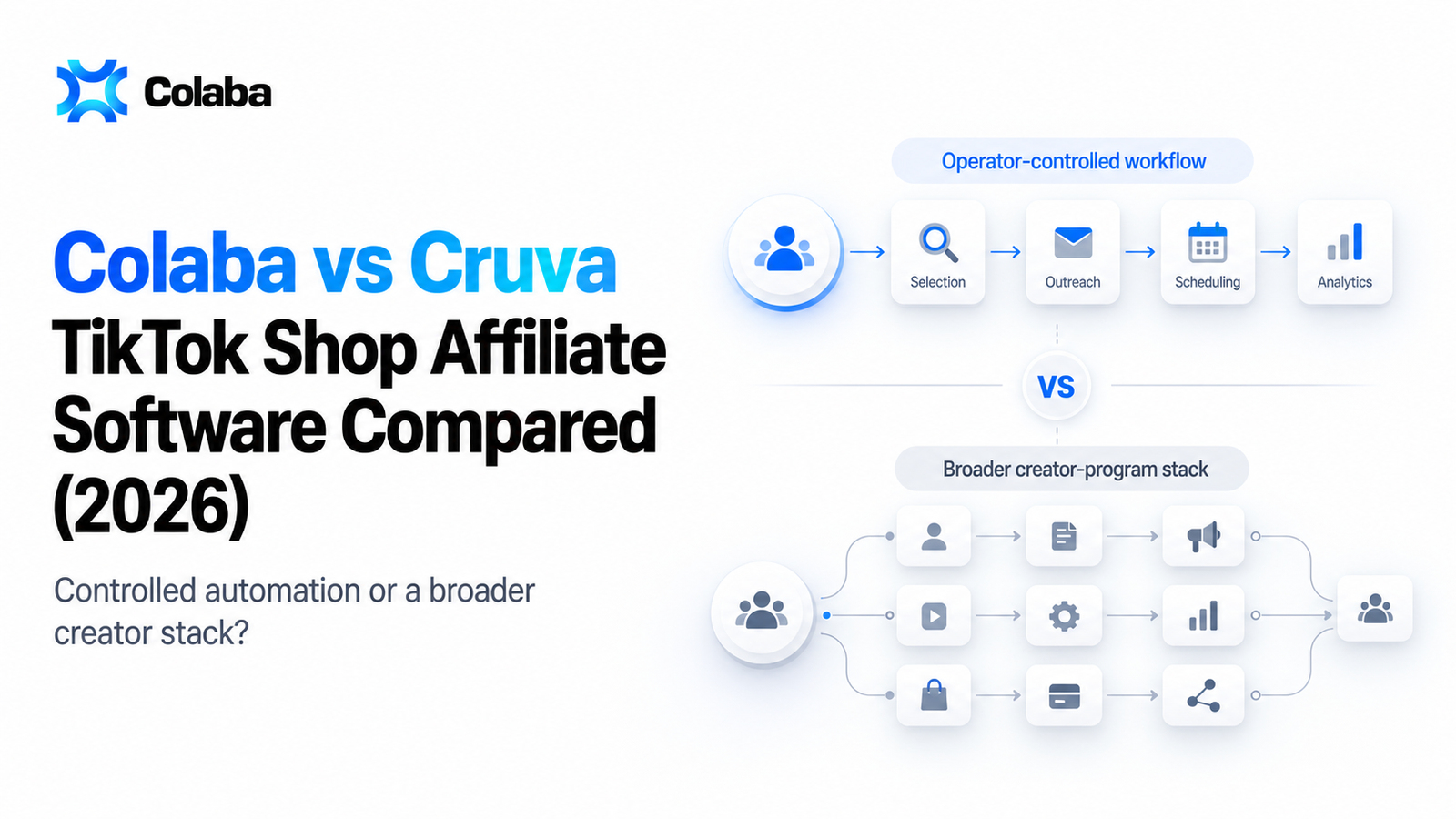
If you searched for Cruva TikTok, Cruva creators, or simply Cruva, the short answer is this: Cruva, formerly UpTk, is creator-growth software for TikTok Shop and wider social commerce. Its public plans cover creator discovery, outreach, relationship tracking, samples, analytics, and automation. Higher tiers add AI search, community, content, and paid-media features.
Colaba is the stronger operational choice for agencies and brands that already have an affiliate method and want to execute it at higher volume. It turns creator research, outreach, collaboration setup, sample follow-up, handoffs, and performance review into a repeatable system. The specialist still owns creator selection, commercial judgment, approvals, quality control, and performance decisions.
Colaba handles recurring execution through a database of 3M+ TikTok affiliates, advanced commerce filters, Invitation, Message, and Mailing Tasks, reusable Templates, recurring Schedules, monitoring, statistics, analytics, and multi-Shop access. Cruva lists a database of 4M+ affiliates. Database size alone does not show how quickly an operator can build a qualified, product-relevant audience and move it into outreach.
Employees spend less time rebuilding lists, copying settings, repeating outreach, and reconstructing history. They can spend that time on creator fit, offers, content feedback, relationships, and judgment.
Colaba is also developing AI-assisted creator search. The work is informed by the Colaba team's and clients' experience with native TikTok Shop search, including the practical limits they meet while building real creator lists. The goal is to improve discovery inside the same controlled workflow. Until that capability is released, buyers should evaluate it as product direction and judge Colaba by the automation, data, and team workflows available now.
This Cruva TikTok alternative comparison focuses on the agency problem Colaba solves: scaling execution while the team keeps responsibility and quality control.
Public pages were checked on September 13, 2026, and Colaba claims were checked against current product documentation. For a wider shortlist, read our comparison of 11 TikTok affiliate management platforms.
Key Takeaways
Built for operational scale
Colaba helps agencies and brands move recurring TikTok Shop affiliate work out of spreadsheets and into one repeatable system.
Automation with ownership
Tasks, Templates, Schedules, and bots carry the repeated work while specialists keep control of rules, approvals, and exceptions.
Visibility for the team
Dashboard, Task history, creator statistics, sample statuses, multi-Shop access, and subaccounts make work easier to monitor and hand over.
AI is part of the direction
Colaba is developing AI-assisted creator search to improve discovery inside an accountable, operator-led workflow.
Why Colaba Is the Stronger Operational Fit for Agencies and Growing Teams
Colaba makes the most sense when the team already knows how it wants to run affiliate operations and needs software to execute that method consistently. Operators can build audiences from creator and commerce data, launch outreach through three Task types, reuse successful configurations, schedule recurring work, track execution, follow sample stages, and keep several Shops visible in one system.
A senior affiliate manager can define a workflow once. Other team members can run or monitor it without rebuilding the logic. Managers see Task status, Shop context, creator data, and exceptions, while agencies keep a consistent process across clients.
Cruva deserves consideration when currently available AI search, creator communities, content moderation, paid-media workflows, or halo measurement are mandatory purchasing requirements. Colaba is the better fit when the immediate problem is repeated TikTok Shop work and the agency wants a focused operating layer for daily execution.
Colaba
Controlled creator operations across discovery, data-led targeting, outreach, reusable automation, statistics, analytics, sample follow-up, team handoffs, and multiple Shops.
Cruva
A broader published feature set across AI search, communities, content, and paid media, with several capabilities reserved for higher-priced tiers.
Recommendation: Start with Colaba when your bottleneck is the amount of manual work required to find, contact, activate, monitor, and report on creators across one or more TikTok Shops. You retain the team's method and judgment while the platform removes repeat execution.
How Colaba Automates TikTok Shop Affiliate Operations
Colaba follows the work an affiliate team repeats every week, from creator data and audience selection to outreach, monitoring, sample follow-up, handoffs, and analysis.
Use creator, product, audience, content, collaboration, and commerce signals to narrow the list.
Send Invitations, TikTok Shop Messages, or email through an approved configuration.
Save a successful setup as a Task Template and run it on a Schedule when needed.
Review execution, creator activity, sample stages, statistics, analytics, and native outcomes.
Cruva creators database vs Colaba commerce filters
Cruva lists a database of 4M+ affiliates in its Basic plan. Colaba's public site lists 3M+ TikTok affiliates and says the database is updated daily. These vendor counts may use different inclusion, geography, activity, and deduplication rules, so 4M versus 3M is not a quality score.
Colaba lets operators filter creators by category, followers, audience age and gender, agency, GMV ranges, engagement, post rate, video and LIVE views, promoted products, previous brand collaborations, and other commerce signals. For an agency, the useful number is the qualified audience left after product, commerce, audience, and collaboration criteria are applied.
Operators can build a dynamic audience with filters or select creators in Authors > Search. The first route applies repeatable rules at scale; the second gives a specialist direct control over a curated list.
Colaba is developing AI-assisted creator search. TikTok Shop's official Find Creators documentation describes personalized recommendations, search, and filters, although operators still need to test product, offer, market, and content fit. Cruva currently publishes AI and lookalike search in Growth. Colaba's current advantage is the direct route from qualified commerce data into Tasks, recurring execution, and monitoring. Read Creator Discovery vs Creator Management for the next stage.
Three Task types cover the main outreach routes
Colaba organizes execution around concrete Tasks. An Invitation Task creates TikTok Shop Target Collaboration offers. A Message Task sends TikTok Shop direct messages. A Mailing Task uses a configured sender and email copy. The team can create these Tasks from filters, selected creators, or an imported audience where the workflow supports it.
Managers can see the configuration, bot or sender, expected actions, execution status, and remaining follow-up. Employees do not have to recover settings and audience logic from an old spreadsheet.
Colaba publishes 10,000 collaborations, DMs, or emails per month in Basic and 100,000 in Pro. Agency lists unlimited DMs, Target Collaborations, and monthly emails. TikTok Shop and connected-account limits still apply, so a team should confirm actual usable capacity during onboarding.
Cruva also publishes email, DM, Target Collaboration outreach, and follow-ups. Its pricing model describes daily unique creator outreach and concurrent automation limits. Colaba's monthly action allowances and Cruva's daily outreach rules are different units, which makes a direct headline comparison unreliable.
During a test, count qualified creators reached, successful actions, failures, follow-ups, and staff time instead of relying on a theoretical maximum.
For channel planning, use our TikTok Shop affiliate email outreach guide. It explains where email fits beside native messages and Target Collaborations.
Templates and Schedules make a proven method repeatable
A Task handles one execution, a Task Template stores the reusable configuration, and a Schedule runs it on selected days and times. A specialist can test the Task, inspect recipients, adjust the setup, and approve recurrence. Every scheduled run produces a Task operators can monitor.
Colaba turns a tested method into repeatable execution. Managers can pause, review, copy, or adjust the workflow when the product, creator pool, season, or client brief changes.
Operational status replaces scattered tracking
Colaba's public site uses the label "CRM for Influencer Status." The operational scope includes statuses, notes, next steps, Task history, outreach records, and sample views, so a colleague can continue the work.
Colaba's relationship-tracking scope is intentionally operational. It is the working layer for TikTok Shop affiliate activity, which suits agencies that already have a sales CRM, project manager, or client reporting system and need a purpose-built place to run creator work.
Cruva describes broader pipeline, message-center, and community workflows. Colaba keeps its focus on TikTok Shop execution. Our affiliate operations guide helps teams map stages and ownership before a trial.
Sample follow-up stays connected to creator operations
Pending sample requests are currently reviewed through TikTok. After approval, Colaba helps teams work with the Ready to Ship, Shipped, In Progress, and Completed stages and run manual or status-based follow-up. The Auto or Manual Approve Type available during Invitation setup is a TikTok sample-offer setting, not an AI review of a Pending request.
Operators can identify records that need action without a separate sample sheet. Cruva publishes AI sample approval in Growth. Colaba keeps the Pending approval decision in TikTok and organizes the surrounding follow-up for specialist review.
Statistics and analytics support better operator decisions
Colaba gives managers four connected views of the work. The Dashboard shows Shop context and operational indicators. Task records show what ran, through which bot or sender, the outreach volume, conversion state, execution status, and timestamps. Authors > Statistics summarizes creator populations. Sample views organize Pending review and the post-approval lifecycle. Pro and Agency include the published Affiliate Market Analytic Dashboard.
| Review level | Current Colaba signals | Decision supported |
|---|---|---|
| Shop | GMV, SKU Orders, Affiliate GMV, affiliate items sold, Shop and bot context | Identify the Shop that needs an operating review and reconcile the period with TikTok. |
| Creator market | Creator categories, GMV and units-sold bands, follower ages, audience and commerce filters | Size a usable segment and tighten the next creator audience. |
| Outreach Task | Task status, assigned bot or sender, outreach volume, conversion state, execution time, timestamps | Find failed, incomplete, or low-yield executions and adjust the next Task. |
| Sample lifecycle | Pending requests, Average PPS, products in queue, stock risk, and Ready to Ship through Completed stages | Prioritize review and follow-up without rebuilding a separate status sheet. |
This structure gives the specialist evidence for the next configuration. It does not turn every displayed value into profit or ROI. For example, sample ROI still requires an agreed cost and attribution model; Average PPS is a product score whose formula should be confirmed before it becomes a management KPI.
Cruva adds cohort, content, paid-media, and halo analysis across higher tiers. Colaba keeps creator data, Task monitoring, Shop performance, and sample status close to the workflow where TikTok Shop operators act on the finding.
GMV, affiliate GMV, estimated GMV, sample ROI, and halo can use different windows, joins, attribution rules, currencies, and refund states. Compare the same creator, product, and period against native data. The TikTok Shop affiliate tracking guide provides a reconciliation framework.
Automation saves time when the team can see what ran, what changed, and where a specialist needs to step in.
Colaba vs Cruva Pricing and Capacity for Growing Teams
Colaba gives teams a lower-cost path into structured TikTok Shop automation. The difference is useful for an agency that wants to prove the workflow with one Shop, expand to two, and then move into a multi-Shop team plan without committing to a broader suite before it needs those modules.
On September 13, 2026, Colaba listed $59 monthly for Basic, $129 for Pro, and $249 for Agency. Cruva listed $199 for Basic, $399 for Growth, and $599 for Scale, with Enterprise priced by quote. Both vendors advertised a 14-day trial. The table uses public monthly prices and does not include discounts, services, taxes, or negotiated terms.
| Platform | Published monthly plans | Relevant progression | Annual entry price |
|---|---|---|---|
| Colaba | Basic $59; Pro $129; Agency $249 | From 1 Shop and 10,000 monthly actions to 5+ Shops, team subaccounts, analytics, and published unlimited outreach categories. | $708 at the monthly Basic rate |
| Cruva | Basic $199; Growth $399; Scale $599; Enterprise custom | Higher tiers add AI search, community, content, paid-media, and other broader-stack features. | $2,388 at the monthly Basic rate |
Sources: Colaba pricing and Cruva pricing, reviewed September 13, 2026. Similar plan names do not indicate equivalent workflow scope.
Colaba leaves more budget for the people running the program
At the visible monthly rates, Cruva Basic costs 3.37 times Colaba Basic, Cruva Growth costs 3.09 times Colaba Pro, and Cruva Scale costs 2.41 times Colaba Agency. The absolute monthly differences are $140, $270, and $350. Over twelve months at the monthly rate, they become $1,680, $3,240, and $4,200. The paired plans are price landmarks, not equivalent bundles.
Colaba Agency is $150 below Cruva Growth and $350 below Cruva Scale. Cruva Basic is $50 below Colaba Agency, but Colaba Agency lists 5+ Shops, five bots, subaccounts, analytics, and extra Shop or bot capacity. Agencies should compare the actual client setup instead of matching plans by name.
Software savings can be reallocated to samples, creator incentives, or specialist time. The team still needs people who understand creator fit, products, commission strategy, content quality, client expectations, and exceptions. Colaba's pricing supports automation while keeping that judgment in the process.
Measure list preparation, setup, repeated execution, reply handling, exceptions, handoffs, reporting cleanup, training, and support. The business case improves when automation removes hours from recurring work and makes fewer items dependent on one employee's memory.
Compare the units that affect your workload
For Colaba, record Shops, bots, monthly actions, filters, subaccounts, and optional extras. For Cruva, record daily unique outreach, concurrent automations, community size, seats, and plan gates. Confirm how multi-channel contact, retries, follow-ups, duplicates, and failures count.
Define activation before the test: accepted Target Collaboration, approved sample, first qualifying post, or first sale. Keep the definition and denominator fixed through the comparison.
Confirm availability for every Shop
Colaba's public site currently states availability for TikTok Shops in the United States and United Kingdom. Cruva publishes a wider market list. Agencies should confirm every Shop separately because market availability does not guarantee identical fields, channels, analytics, or TikTok permissions.
Check the Shop market, creator pool, data fields, connection method, plan entitlement, and account-specific TikTok limits before purchase. Current TikTok Shop terms and the vendor contract govern the account.
Cruva TikTok vs Colaba: Where the Platforms Differ
The products overlap in creator discovery, outreach, sample operations, and analytics. Their emphasis differs. Colaba is centered on controlled execution for TikTok Shop teams that want to automate a process they understand. Cruva TikTok software has expanded from its UpTk roots into a broader collection of creator growth modules, with AI and community functions spread across higher tiers.
Colaba is built for the team that owns the process
- The team has a repeatable affiliate method that still depends on copied settings, spreadsheets, or one-off manual runs.
- Specialists need to control creator criteria, products, channels, timing, approvals, and exceptions.
- Managers want proven Tasks to become reusable Templates and recurring Schedules.
- Several Shops or clients need consistent execution history, statistics, analytics, status visibility, and team access.
- The business wants automation to free employee time for creator strategy, offer design, relationships, and quality review.
This combination is especially relevant for agencies. Colaba Agency publishes support for 5+ Shops, five included bots, team subaccounts, the Affiliate Market Analytic Dashboard, and premium support. Extra bots or Shops are listed at $29 per month each. Use our software requirements guide to test permissions, Shop boundaries, and reporting before rollout.
When Cruva may fit a different purchasing brief
- You need AI and lookalike discovery as a released capability today.
- A private creator community, contests, rewards, or repeat-post programs are central to the purchase.
- The team wants paid-media or off-platform halo modules inside the same subscription.
- The required Shop market falls outside Colaba's current public USA and UK availability.
Those needs are legitimate, although they are not the same as the daily automation problem Colaba solves. A team should calculate whether each additional module replaces current work, replaces another paid tool, or simply adds a feature that looks useful during a demo.
A small program with little repeated work may remain in TikTok Shop's native tools. Colaba becomes easier to justify when list building, repeated outreach, handoffs, multi-Shop work, sample follow-up, or reporting consumes staff time every week. The TikTok Creator Marketplace alternatives guide explains when a dedicated operating layer becomes useful.
Colaba's automation has a clear control boundary
This boundary helps large teams scale responsibly. The platform handles repetition and preserves visibility. Named operators remain accountable for the program and can intervene when data, context, or quality calls for judgment.
A useful buying test: ask whether the platform makes a proven process easier to repeat, supervise, and hand over. Colaba is designed around those three operational results.
Test Colaba Against Your Manual Baseline
A Colaba pilot should answer one business question: how much recurring work can the platform remove while the team keeps the controls it needs? Start with a real process, record the manual baseline, and use the same products, market, audience rules, users, and success thresholds.
Count preparation time, repeated steps, handoffs, errors, and unresolved items.
Build two product audiences, inspect a fixed sample, and launch an approved channel.
Save the approved setup as a Task Template and test a scheduled run.
Pause, adjust, hand off, and resolve sample or outreach exceptions.
Compare preparation, execution, errors, handoffs, visibility, outcomes, and cost.
Use a workflow the team already understands
Before Day 1, define qualified creator, successful contact, sample outcome, qualifying post, native GMV window, and operator minute. Record the time needed to build the audience, recreate settings, launch the outreach, monitor it, hand it over, and prepare a report.
Label a fixed creator sample as eligible, ineligible, uncertain, duplicate, or missing data. Test a failed action, an unresolved item, a sample review, a missed deadline, and a handoff. Reconcile at least ten creator-product rows to native TikTok Shop data.
Questions to settle before a full rollout
- Which Shops, users, channels, filters, automation controls, analytics, and support paths are included in the selected Colaba plan?
- What consumes an allowance, and how do follow-ups, failures, retries, and duplicates count?
- Which values are native, calculated, or estimated, and can the supporting records be exported?
- Which decisions remain with the operator, and how can a scheduled workflow be paused, changed, or reviewed?
- Which permissions, subaccounts, extra Shops or bots, services, renewal, and cancellation terms affect total cost?
For a broader evaluation framework, use TikTok Affiliate Management Software: 12 Requirements to Evaluate. It turns a feature discussion into a test of operational fit.
Why Colaba Is a Strong Choice for Serious TikTok Shop Teams
Colaba brings creator research, audience building, Invitation, Message, and Mailing Tasks, reusable Templates, recurring Schedules, execution monitoring, sample follow-up, statistics, analytics, and multi-Shop work into one operational system.
Its strongest fit is a team with real expertise and too much manual repetition. The specialist defines creator criteria and commercial context, tests the first run, decides which setup can recur, reviews results, and handles exceptions. Colaba makes that method faster to execute, easier to monitor, and less dependent on one person's files or memory.
Pro and Agency include the published Affiliate Market Analytic Dashboard. Agency adds team subaccounts and capacity for 5+ Shops with five included bots. Colaba is also developing AI-assisted creator search so teams can gain more help during discovery while preserving the operating model built around specialist control.
TikTok Shop remains the native source for platform permissions, Pending sample decisions, collaboration status, and material outcomes. Colaba gives the team the dedicated automation layer needed to work with those processes at greater scale.
See how much of your current workflow Colaba can automate
Bring one recurring affiliate process to the demo. We will map the creator data, Tasks, Templates, Schedules, analytics, team access, and operator checkpoints around the way your team already works.
Frequently Asked Questions
What is Cruva TikTok software?
Cruva, formerly UpTk, is creator-growth software for TikTok Shop and wider social commerce. Its public plans include creator discovery, outreach, relationship tracking, sample management, analytics, and automation. Higher tiers add AI search, creator communities, content workflows, and paid-media features.
What does Colaba automate?
Colaba automates repeatable parts of TikTok Shop affiliate operations through creator filters, Invitation, Message, and Mailing Tasks, reusable Task Templates, recurring Schedules, outreach execution, sample follow-up, and monitoring. The workflow connects creator data with the work a team needs to run and review.
How does the Cruva creators database compare with Colaba?
Cruva lists 4M+ affiliates, while Colaba lists 3M+ TikTok affiliates. Vendor counts may use different market, activity, inclusion, and deduplication rules. Colaba emphasizes commerce and audience filters that help an operator narrow the database to creators who fit a product and outreach brief.
Does Colaba have AI creator search?
Colaba is developing AI-assisted creator search, informed by the team's and clients' practical experience with TikTok Shop creator discovery. This comparison records it as product direction. Current discovery uses creator data, commerce signals, advanced filters, statistics, and manual selection.
Is Colaba a full CRM?
Colaba provides operational status tracking for TikTok Shop affiliate work, including creator statuses, notes, next steps, Task history, outreach records, and sample-lifecycle views. Its focus is keeping creator operations organized and visible to the team. A general-purpose sales CRM serves a broader record-keeping role.
Does Colaba support multiple TikTok Shops?
Yes. Colaba lists one Shop in Basic, two in Pro, and 5+ Shops with five included bots in Agency. Agency also includes team subaccounts, and extra bots or Shops are listed at $29 per month each. This structure is designed for brands with several Shops and agencies managing client portfolios.
How much do Colaba and Cruva cost?
On September 13, 2026, Colaba listed monthly prices of $59 for Basic, $129 for Pro, and $249 for Agency. Cruva listed $199 for Basic, $399 for Growth, and $599 for Scale, with Enterprise by quote. The plans have different limits and feature scope, so compare the workflow required by your team.
Why use Colaba when TikTok Shop already has affiliate tools?
TikTok Shop remains the native source for permissions, collaboration status, Pending sample decisions, and material outcomes. Colaba adds a dedicated operating layer for creator research, structured outreach, reusable automation, monitoring, statistics, analytics, multi-Shop work, and team handoffs when native tools and spreadsheets require too much repeated work.