
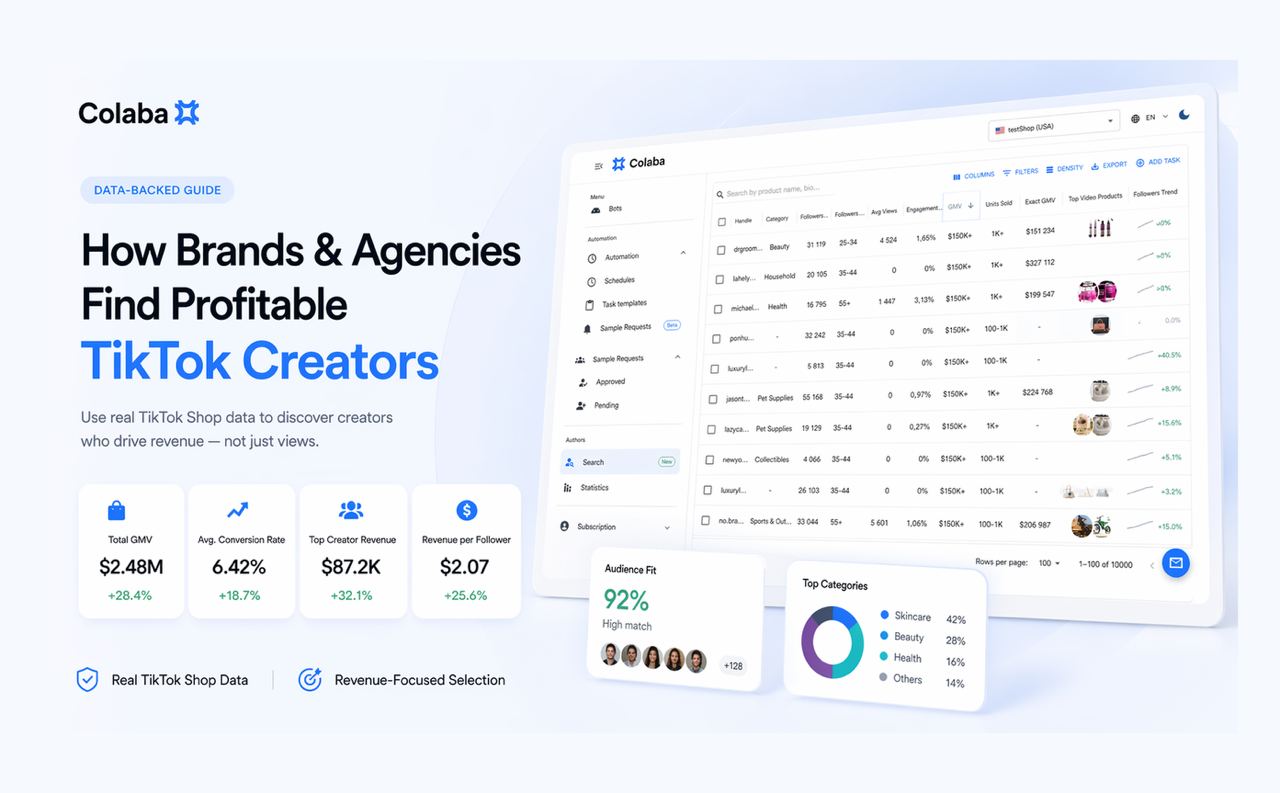
Problem: The biggest reason brands & agencies lose money on TikTok isn’t product quality — it’s choosing creators using the wrong metrics.
Core insight: The most profitable TikTok creators are rarely the most visible — they’re the ones with strong conversion signals, buyer-aligned audiences, and repeatable sales performance.
Data source: In our TikTok Shop Creator Analysis 2026 , we analyzed March creator performance across GMV, conversion rates, and revenue per follower etc.
Key finding: Creators driving the most attention are often not the ones generating the most revenue.
1. Why Most Brands Pick the Wrong Creators
The biggest trap is simple: brands optimize for what’s visible.
Views, likes, followers — they feel like indicators of success. But in reality, they measure attention, not buying intent. When we looked deeper into the data, the pattern became impossible to ignore. Some of the highest-performing creators weren’t the biggest — they were simply better at converting.
Below are real examples from our March 2026 analysis:
| Creator | Followers | Categories | GMV (Median) |
|---|---|---|---|
| @holisticcglowupp | 11,242 | Health, Beauty, Food | $296,022 |
| @cliplagoon | 42,194 | Health, Beauty, Food | $268,651 |
| @100proofflowfitness | 704,078 | Sports, Health, Beauty | $214,421 |
What stands out immediately: the smallest creator here generated the highest revenue. Not because of reach — but because of audience intent, product fit, and conversion-driven content. More followers don’t guarantee more revenue. In many cases, they dilute it. Viral content is built to be watched. Profitable content is built to convert.
One of the most accurate explanations comes directly from a Reddit discussion among marketers and sellers:
“You're selecting on content metrics. Conversions run on relationship metrics. Engagement shows how well someone creates content. But purchases depend on trust.”
A creator with 60K followers and polished viral videos often attracts people who scroll and like. A creator with 15K followers who talks about products naturally attracts people who click and buy.
Another systemic issue: brands follow the herd. Big creators feel “safe.” They look validated by numbers. But this leads to overpaying for reach that doesn’t convert.
Meanwhile, micro-creators (10K–100K followers) — and even nano-creators (1K–10K followers) — often outperform because they operate in tighter, higher-intent niches:
- Stronger audience trust
- Higher engagement quality
- Clear niche positioning
And this isn’t theoretical — the numbers back it up:
| Creator | Followers | Category | GMV |
|---|---|---|---|
| @bmccollectibles | 10,703 | Collectibles | $755,315 |
| @homevibeswithmia | 6,225 | Furniture, Textiles | $616,393 |
| @beautyusacloth | 4,320 | Apparel, Sports | $211,378 |
| @beautypickshub | 4,172 | Beauty, Health | $408,240 |
What stands out immediately: creators with under 15K followers are generating hundreds of thousands in GMV. In fact, industry data shows micro-influencers consistently deliver higher engagement and more authentic connections than large creators.
There’s also a deeper structural problem: Most influencer marketing is measured incorrectly. Brands track discount codes, clicks, or views — but miss delayed conversions, trust effects, and repeat purchases. Which creates a dangerous illusion:
“This creator performed well” — when in reality, they just performed visibly.
2. How Brands Identify Profitable TikTok Creators
Finding a profitable creator isn’t about guessing — it’s a step-by-step evaluation process. Here’s how brands actually identify creators worth working with:
1. Start with Performance Signals
First, filter creators by their ability to generate revenue — not attention. This answers one question: can this creator actually sell?
2. Validate Audience–Buyer Match
Strong engagement doesn’t mean strong buying intent. The creator’s audience must match your actual buyer — in age, interests, and purchasing behavior. If the audience doesn’t buy, performance metrics won’t scale.
3. Analyze Content–Brand Fit
Don’t just look at metrics — analyze the content itself.
- Does the tone of voice match your brand?
- Does the product feel natural in their content?
- Is the format persuasive for this specific product?
Even strong creators underperform if the content doesn’t match the product. A good creator doesn’t just show the product — they make it convincing.
4. Evaluate Trust Density
Smaller creators often outperform because trust is more concentrated. Their audience doesn’t just watch — they listen and act. More reach spreads attention. Less reach concentrates trust.
5. Confirm Product Fit (Not Just Category Fit)
Category alignment isn’t enough. A creator might perform well in beauty — but that doesn’t mean they’ll sell every type of beauty product. What matters is whether your product fits their existing content format and buying behavior.
- Routine-based vs transformation content
- Impulse buy vs considered purchase
- Visual result vs long-term benefit
The closer the match, the higher the conversion. Creators don’t sell categories — they sell formats.
If you want to quickly apply this framework, use this checklist:
- Conversion rate ≥ 2–3%
- Revenue per follower ≥ $3
- GMV → consistent, not one-off spikes
- Views → stable, not viral-only
- Audience match → aligns with your buyer
- Content fit → matches your brand tone & format
- Trust density → audience actually listens & buys
- Product fit → fits creator’s selling format
Most of these signals can be filtered automatically using creator analytics tools.
3. Ways to Find TikTok Creators
Manual Search
This is where most people start — scrolling TikTok, saving creators, checking trends. It works for discovery, but breaks when you need to evaluate and choose.
TikTok is built to surface engaging content, not to help you assess creator performance — which makes it difficult to compare creators or understand who actually drives results.
Creator Marketplaces
Marketplaces look more “professional,” but they still miss the core signal. You get profiles and filters — but not performance. These platforms are built for awareness, not profitability.
Data-Driven Tools
This is where the game changes. Instead of guessing, you can filter creators using real performance and audience signals. Tools like Colaba allow you to narrow down creators using precise filters:
- Category & niche → match your product segment
- Follower range → focus on micro or scalable creators
- Audience demographics → gender, age alignment
- GMV ranges → proven revenue performance
- Units sold → real demand, not just reach
- Engagement rate → content quality signal
- Average views (video / live) → consistency, not spikes
For deeper analysis, you can go further:
- GMV per customer → buying power & AOV proxy
- GPM (GMV per mille) → monetization efficiency
- Top video products (by sales volume) → identify creators behind best-selling items
- Content volume → number of videos, live sessions
- Brand collaborations → commercial experience
With the right filters, you’re not searching anymore — you’re systematically identifying creators with the highest probability of driving revenue.
4. How to Turn Creators into Revenue Channels
Finding the right creator is only half the work. The real impact comes from how you use them. High-performing brands don’t treat creators as one-time placements — they treat them as scalable channels.
1. Double Down on What Works
If a creator converts, don’t move on — go deeper.
- Reuse the same format
- Test multiple variations of the same product
- Scale what already performs
2. Focus on Repeatable Formats
The best-performing content isn’t random — it follows a pattern:
- Problem → Solution
- Before → After
- Demo → Result
If a format works once, it can work again.
3. Increase AOV, Not Just Volume
Scaling isn’t only about more views — it’s about better economics.
- Bundle products
- Test higher-value SKUs
- Optimize for margin, not just sales
The goal isn’t more creators — it’s more revenue per creator.
5. TikTok Commerce Is Changing Fast
TikTok is no longer just a discovery platform — it’s becoming a full-scale commerce engine. In 2026, the algorithm is no longer optimizing purely for views. It increasingly rewards content that drives engagement, retention, and transactions. This means one critical shift:
Creators who convert are being amplified. Creators who don’t are fading.
At the same time, user behavior is evolving.
- More users are discovering products directly inside TikTok
- Impulse buying is increasing through short-form content
- Trust in creators is replacing traditional ads
The result is a new reality for brands:
TikTok is no longer about reach — it’s about performance-driven distribution. And as competition increases, the gap between “visible creators” and “profitable creators” will only grow. Brands that rely on views will keep guessing. Brands that rely on data will keep scaling.
6. Find Revenue-Proven TikTok Creators
Identify creators who consistently drive sales — and make data-backed decisions instead of relying on guesswork. Filter creators by GMV, conversion rate, audience fit, and product category to uncover the highest-performing opportunities faster. Compare creators side by side, validate performance signals, and build smarter shortlists for every campaign. Scale partnerships with creators who generate measurable ROI, not just views with Colaba.
7. FAQ
How do you find TikTok influencers?
Finding TikTok influencers starts with discovery, but real results come from filtering. Instead of relying on views or followers, focus on creators with proven sales performance. Look at metrics like conversion rate, GMV, and revenue per follower. The most effective approach combines manual discovery with data-driven tools that allow you to identify creators who consistently drive revenue, not just engagement.
What makes a TikTok creator profitable?
A profitable TikTok creator is someone who consistently converts attention into revenue. This typically includes having a strong conversion rate, high revenue per follower, and a repeatable content format that drives sales. Beyond metrics, profitability also depends on audience intent, product fit, and trust. Creators who solve problems and integrate products naturally tend to outperform those focused purely on entertainment.
How much do TikTok creators earn?
TikTok creator earnings vary widely depending on niche, audience quality, and monetization strategy. Some creators generate only a few hundred dollars per month, while others drive six-figure GMV through TikTok Shop. Importantly, earnings are not directly tied to follower count. Smaller creators with high trust and strong product fit often outperform larger creators in revenue generation.
What tools help find influencers?
Tools that provide performance data are the most valuable for finding influencers. Platforms like Colaba allow you to filter creators by GMV, conversion rate, audience demographics, and product performance. Unlike basic marketplaces, these tools help identify creators who actually generate sales. The ability to analyze real data significantly reduces guesswork and improves campaign outcomes.
Are smaller creators better than big influencers?
In many cases, smaller creators outperform larger influencers, especially in commerce-driven campaigns. Micro and nano creators tend to have higher trust and more engaged audiences, which leads to better conversion rates. While large creators provide reach, smaller creators often deliver stronger ROI because their recommendations feel more authentic and actionable to their audience.
What is the biggest mistake in influencer marketing?
The biggest mistake is choosing creators based on visibility instead of performance. Many brands prioritize views, likes, or follower count, which can be misleading. Without analyzing conversion metrics, audience intent, and product fit, campaigns often fail to generate revenue. Successful influencer marketing requires focusing on creators who can consistently drive measurable business results.