
Period: 2021–2026
Platform: TikTok Shop
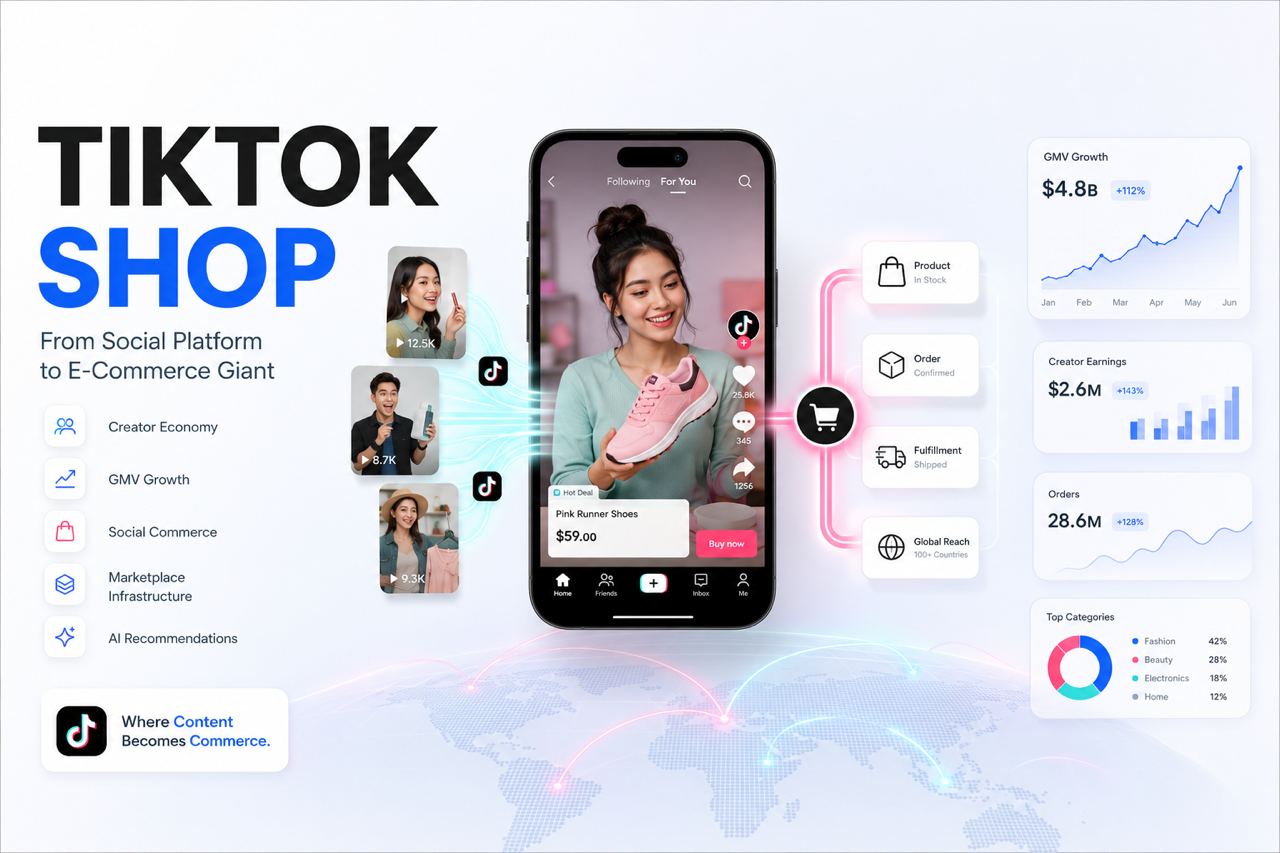
Core insight: TikTok Shop is growing faster than traditional e-commerce platforms because it turns short-form content, creator trust, affiliate incentives, and algorithmic recommendations into one purchase system.
Key finding: The future of e-commerce is shifting from search-led shopping to recommendation commerce, where AI-powered feeds, creator credibility, and affiliate distribution shape demand before consumers actively search for products.
Methodology & sources: Market size, GMV, and social commerce estimates were compiled from public industry reports, official TikTok Shop announcements, third-party research, and internal Colaba DATA creator-commerce analysis. Sources include eMarketer, Bloomberg, Momentum Works, BeautyMatter, DataSlayer, Marketplace Pulse, and related e-commerce intelligence platforms.
1. TikTok Shop Is Transforming Global E-Commerce
TikTok Shop is growing faster than traditional e-commerce platforms because it does not wait for shoppers to search. It creates demand inside the feed, using short-form video, creators, affiliate incentives, and instant checkout to move users from discovery to purchase in one session.
For marketers, agencies, and sellers, this changes customer acquisition economics. Amazon captures existing demand, Google Shopping monetizes search intent, and Meta monetizes targeting. TikTok Shop increasingly generates demand through recommendation commerce, where products reach buyers before they search.
This report goes beyond public TikTok Shop growth statistics by connecting GMV forecasts, market observations, creator data, and creator economy trends into one operating model. TikTok Shop revenue growth is not only a marketplace story; it is the convergence of social commerce, affiliate marketing, UGC, algorithmic recommendations, and short-form entertainment.
By 2026, TikTok Shop will no longer be merely an add-on to the social network. The platform is evolving into retail infrastructure that is changing the traditional model of online sales. While Amazon was built around search demand and Meta around ad targeting, TikTok Shop is betting on content commerce, where a purchase begins with engagement rather than the intention to buy a product.
According to estimates by analysts at eMarketer and Bloomberg, TikTok Shop’s revenue forecasts could exceed $100 billion in global GMV as early as 2026. Some forecasts estimate the U.S. market at $23.4 billion, with global sales reaching approximately $112 billion. By comparison, many traditional marketplaces, such as eBay and Amazon, took decades to reach comparable scales.
How large is TikTok Shop today?
TikTok Shop is already a multi-billion-dollar GMV platform, with growth concentrated in Southeast Asia, the United States, and selected expansion markets. Public datasets vary by methodology, but point in the same direction: TikTok Shop market share is still smaller than Amazon’s in mature markets, yet its growth rate is unusually high for a retail platform at this scale.
TikTok Shop GMV Growth (Global vs US):
| Year | Global GMV (TikTok Shop) | US GMV (TikTok Shop) | Notes |
|---|---|---|---|
| 2021 | ~$1B | N/A | Early TikTok Shop rollout focused mainly on Southeast Asia |
| 2022 | ~$4.4B | N/A | Rapid expansion across Asia markets and creator commerce ecosystems |
| 2023 | ~$13–16B | <$1B | Official US launch begins; aggressive seller onboarding starts |
| 2024 | ~$32–33B | ~$9B | Major US growth driven by Black Friday, creators, and viral commerce |
| 2025 | ~$64B | ~$15.8B | TikTok Shop becomes one of the fastest-growing social commerce platforms globally |
| 2026 (forecast) | ~$100–112B | ~$20–23B | Analysts project continued expansion in US and European markets |
Which countries drive TikTok Shop growth?
TikTok Shop growth was driven first by Southeast Asia, then by rapid U.S. adoption, with Europe becoming the next expansion layer. Indonesia, Thailand, Vietnam, Malaysia, and the Philippines helped prove the model, while the U.S. matters because of its ad market, mature creator economy, and higher average order values.
This expansion pattern matters because TikTok Shop adoption does not spread like a conventional marketplace rollout. It grows where active creators, content-driven buying behavior, and seller investment in affiliates, samples, and logistics overlap.
Why should brands and agencies care?
Brands are moving to TikTok Shop because it combines awareness, social proof, affiliate distribution, and checkout inside one measurable channel. For agencies, it creates services around creator discovery, creator outreach, affiliate management, UGC production, and creator analytics rather than only media buying.
TikTok Shop’s growth isn’t just about increased sales. The platform is gradually shifting the retail market’s focus toward entertainment-driven commerce.
That’s why more brands are reevaluating their TikTok Shop seller strategy for 2026 and investing in creator-led commerce. Just a few years ago, social commerce was supplementary. Now, the landscape is changing. TikTok Shop is already shaping how brands approach marketing, launch new products, and scale performance advertising. This is particularly evident in categories such as beauty, fashion, wellness and gadgets, where visual product demonstrations can directly impact conversion rates.
2. Why TikTok Shop is growing faster than traditional platforms
Most major marketplaces grew by attracting sellers, expanding selection, and then increasing demand. TikTok Shop uses a different approach. The platform scales sales through content, algorithms, and the creator economy, shortening the path from viewing to purchasing to just a few seconds. That is why TikTok Shop has reached multi-billion-dollar GMV in just a few years.
TikTok Shop also benefits from algorithmic distribution. In traditional e-commerce, sellers compete for search rankings or raise ad budgets. On TikTok, a product can receive millions of views organically if the content appears in recommendations . Viral distribution can scale faster than traditional performance marketing.
Why is TikTok Shop growing so fast?
TikTok Shop is growing so fast because product discovery, trust-building, and conversion happen in the same environment. A creator video can introduce the product, demonstrate the use case, answer objections, trigger affiliate incentives, and send the shopper directly to checkout without a separate funnel.
Analyst observation: this differs from Amazon’s growth because Amazon scaled by indexing products and improving fulfillment, while TikTok Shop scales by indexing attention. The more users watch, comment, save, and buy, the more the recommendation system learns which products deserve distribution.
TikTok Shop vs Amazon growth model
| Growth factor | Amazon marketplace | TikTok Shop | Strategic implication |
|---|---|---|---|
| Demand source | Existing product search | Feed-based product discovery | Brands must create demand, not only capture it. |
| Trust signal | Reviews, ratings, delivery reliability | Creators, UGC, comments, live proof | Creator fit can influence conversion as much as listing quality. |
| Scaling lever | Catalog depth, search ranking, logistics | Content volume, affiliate reach, algorithmic distribution | Content velocity becomes a retail growth asset. |
| Acquisition economics | Search ads and marketplace competition | Creator commissions, samples, organic recommendations | Efficient creator selection can reduce paid media dependence. |
The new commerce model is more aggressive than the traditional marketplace approach. TikTok Shop combines entertainment, affiliate marketing, the creator economy, and instant checkout in one platform. As a result, content is no longer just a tool for driving traffic, but a full-fledged sales engine.
TikTok Shop is changing the way products are discovered, trusted, and purchased — moving commerce from search-based intent to content-driven attention. Instead of users searching for products, products are continuously pushed into attention flows through content consumption. This changes how discovery, trust, and conversion operate in modern e-commerce.
Intent-Based Commerce
Users already know what they want and actively search before making a purchase.
Attention-Driven Commerce
Products are discovered inside entertainment flows, where content, creators, recommendations, and checkout work as one sales system.
For brands and agencies, this is a shift in sales strategy. Growth on TikTok Shop is no longer driven primarily by media buying or static product listings. Instead, scalable sales increasingly depend on continuous creator testing, high-volume UGC production, fast content iteration, and the ability to react to algorithmic demand in real time.
This is where operating systems become important. Teams that scale TikTok Shop need structured workflows for creator discovery, creator outreach, affiliate management, TikTok category analysis, creator analytics, and TikTok Shop software that connects creators to sales outcomes.
3. What Actually Sells on TikTok Shop (Key Growth Categories)
TikTok Shop has already identified the categories that consistently account for the lion's share of GMV on the platform. The main pattern remains unchanged: the best-selling products are those that can be quickly shown in a video, integrated into creator content, and emotionally explained within the first few seconds of viewing. That is precisely why the TikTok Shop seller strategy for 2026 is increasingly shifting toward visual-first products and creator-led commerce.
According to TikTok Shop creator analytics platform Colaba internal data for April 2026, certain categories on TikTok Shop continue to show explosive GMV growth, particularly in the beauty, wellness, fashion, and home products segments. This confirms a major market trend: users are increasingly purchasing products not through search, but through recommendation-driven content.
Top 10 TikTok Shop Categories by GMV in April 2026 (Colaba’s internal data):
| Categories | GMV | Percentage of category | Unique count of creators |
|---|---|---|---|
| Beauty & Personal Care | $163.3M | 25.4% | 1,145,067 |
| Womenswear & Underwear | $107.6M | 16.7% | 1,070,187 |
| Sports & Outdoor | $93.9M | 14.6% | 465,926 |
| Health | $69.9M | 9.2% | 292,176 |
| Home Supplies | $46.9M | 7.3% | 369,884 |
| Phones & Electronics | $46.3M | 7.2% | 540,117 |
| Fashion Accessories | $45.2M | 6.0% | 567,147 |
| Household Appliances | $39.6M | 5.9% | 129,856 |
| Food & Beverages | $37.8M | 5.3% | 353,354 |
| Furniture | $35.0M | 1.2% | 85,255 |
| Other | $23.6M | 1.3% | 248,039 |
Key Findings by TikTok Shop Category
Beauty & Personal Care remains the undisputed leader on TikTok Shop, accounting for 25.4% of GMV. The category continues to dominate thanks to highly visual content, creator trust, and strong impulse-buy behavior.
Womenswear & Underwear (16.7%) and Sports & Outdoor (14.6%) demonstrate that TikTok is increasingly influencing lifestyle-driven shopping. Users are buying not just a product, but the lifestyle that the creator conveys.
Home Supplies and Phones & Electronics each account for roughly the same share of GMV (~7%). This confirms the growth of “problem-solution commerce,” where short videos quickly demonstrate a product’s utility and prompt an immediate purchase.
Fashion Accessories, Food & Beverages, Toys & Hobbies, and Automotive currently hold a smaller market share (3.6 - 7%) but demonstrate high viral potential through creator collaborations and recommendation-driven traffic.
Categories with long customer journeys or weak visual presentation continue to scale significantly less effectively on TikTok Shop. The platform operates as an attention-driven commerce ecosystem, where emotion, entertainment, and instant product perception often outperform rational product comparison.
The easier it is to demonstrate a product’s impact within the first 3–5 seconds of a video → the higher the probability of viral reach and conversion growth.
- Fast visual comprehension increasingly matters more than detailed product specifications;
- Creator-native storytelling outperforms traditional polished advertising formats;
- Entertainment-driven shopping behavior is becoming a primary driver of product discovery and conversion;
- TikTok Shop seller strategies in 2026 are shifting toward scalable UGC systems, creator testing velocity, and content iteration rather than purely media-buying optimization.
4. How TikTok Is Changing the Mechanics of E-Commerce
1. From Search-Based Commerce to Discovery Commerce
For decades, traditional e-commerce has been built around search intent. Users would visit Amazon, Google, or a marketplace with a specific query in mind: to find a particular product, compare specifications, or find the best price. TikTok Shop is changing the very mechanics of online shopping, transforming the purchase into a discovery-driven experience.
Now, demand is generated not through search, but through an algorithmic feed of recommendations. A user may not be planning a purchase, but might see a product within entertaining content, receive social proof, and place an order right while watching a video. That is why the TikTok Shop seller strategy for 2026 is increasingly built around attention-first commerce, rather than search-based acquisition.
Marketplace vs discovery commerce
| Commerce model | Primary user behavior | Main platforms | What wins |
|---|---|---|---|
| Marketplace commerce | Search, compare, filter, review | Amazon, eBay, Google Shopping | Price, delivery, reviews, listing optimization |
| Social commerce | Discover through content and communities | TikTok Shop, Instagram, YouTube, Meta apps | Creator trust, UGC, entertainment, social proof |
| Recommendation commerce | Receive personalized product suggestions in-feed | TikTok Shop and AI-powered shopping feeds | Behavioral signals, content velocity, algorithm fit |
For brands, this signifies a fundamental shift in the consumer journey. Product discovery is moving from search results to the creator ecosystem, where recommendations and viral content are becoming the primary source of demand generation.
2. Content Replaces the Storefront
Within TikTok Shop, short-form video content is gradually taking over the role of the traditional product page. Whereas product cards, SEO descriptions, and marketplace rankings used to be the primary sales tools, demonstrations, tutorials, creator reviews, and before-and-after videos now play a key role.
Users make decisions faster because they immediately see the product “in action”. The video simultaneously shows the result, the usage scenario, and the audience’s emotional reaction. As a result, content is no longer just a supplement to the storefront but a full-fledged sales infrastructure within the platform. This is precisely why scaling brands on TikTok Shop directly depends on the volume of creator-native content and production speed.
UGC matters because it changes consumer behavior at the moment of evaluation. Instead of reading a static product description, shoppers watch a real person demonstrate the result, explain the tradeoff, and frame the product as part of a lifestyle or problem-solution routine.
3. The creator economy is becoming retail infrastructure
TikTok Shop is changing not only the format of content but also the distribution system itself. In traditional e-commerce, brands relied on paid traffic, SEO, or marketplace algorithms. Now, creators are beginning to play a key role, simultaneously building trust, launching product trends, and driving sales.
The creator economy is effectively transforming into a new retail infrastructure. Recommendations are replacing digital merchandising, and creator videos are becoming a new version of the storefront experience. Users are buying not only the product but also trust in the person recommending it.
Affiliate commerce accelerates this shift because it gives creators a financial reason to keep testing products, formats, and audiences. When affiliate incentives are aligned with creator credibility, TikTok Shop can turn thousands of independent creators into a distributed sales force without forcing every brand to build its own media network from scratch.
4. Impulse purchases are becoming the new norm
Impulse purchases are rapidly becoming the dominant buying behavior inside TikTok Shop. The platform dramatically shortens the path from product discovery to checkout by combining entertainment, social validation, and instant purchasing within a single feed.
Research on TikTok consumer behavior shows that purchase intent is often formed within the first seconds of content exposure, especially in visually demonstrable, low-to-mid price categories. Studies on short-form video commerce and impulse buying consistently highlight that emotional engagement, creator trust, and algorithmic recommendations significantly accelerate conversion decisions.
For the broader e-commerce market, this represents a major strategic shift: engagement speed, creator-native storytelling, and algorithmic distribution are becoming more influential than traditional long-form customer journeys and performance advertising funnels.
Why is TikTok Shop different from Amazon?
TikTok Shop is different from Amazon because it starts with recommendation rather than search. Amazon is strongest when shoppers already have intent; TikTok Shop is strongest when content creates intent, validates the product through creators, and turns attention into checkout before a shopper compares alternatives elsewhere.
This also explains why TikTok Shop competes differently with Meta, Instagram, YouTube, and Google Shopping. Meta and Instagram have strong social graphs and advertising systems, YouTube has deep video authority, and Google Shopping captures product search intent. TikTok Shop’s advantage is the tight connection between short-form entertainment, algorithmic discovery, affiliate commerce, and native checkout.
5. What lies ahead for TikTok Shop in the next 1–5 years
The history of major marketplaces shows that platforms rarely remain merely “places to sell.” Amazon started as an online bookstore but later evolved into a technology ecosystem featuring Prime, Alexa, AWS, its own logistics, and AI-powered recommendations. Shopify built an infrastructure for independent brands, while Temu and Shein focused on ultra-fast product testing and algorithmic demand generation. Judging by its growth rate, TikTok Shop is following its own path—at the intersection of entertainment, AI, and commerce.
What is the future of TikTok Shop?
The future of TikTok Shop is likely to be shaped by AI-personalized product discovery, broader international expansion, stronger seller infrastructure, and more automated affiliate commerce. If TikTok continues connecting behavioral data, creator performance, product signals, and checkout outcomes, the platform could become one of the most important social commerce growth channels globally.
The key advantage of TikTok Shop lies in the scale of its behavioral data ecosystem. Unlike traditional marketplaces, TikTok continuously analyzes real-time engagement signals across content consumption, creator interaction, and shopping behavior.
- What users watch and which content formats hold attention longest;
- Which videos generate deeper engagement through watch time, rewatches, and interaction patterns;
- Which creators build the highest trust and influence purchasing decisions;
- Which products trigger impulse-buy behavior inside entertainment-driven feeds.
This lays the groundwork for the next phase of recommendation commerce. In the coming years, TikTok Shop could evolve into more than just a marketplace—it could become an AI-driven shopping ecosystem where algorithms predict purchases even before a clear search intent emerges.
AI recommendations can produce exponential product discovery because every interaction improves the next distribution decision. Watch time, rewatches, comments, saves, creator affinity, purchase behavior, and refund signals can all help the platform decide which products should be shown to which audience segments next.
One of the most likely directions for TikTok Shop’s evolution is AI-personalized commerce. As recommendation systems become more advanced, the platform could gradually transform from a content feed into a fully adaptive shopping environment tailored to each individual user.
- AI shopping assistants capable of guiding product discovery and purchase decisions;
- Personalized product feeds dynamically optimized around behavioral patterns and interests;
- Voice-commerce integration which eliminates barriers from product search to checkout;
- AI-generated storefronts automatically customized for different audience segments and user profiles.
The next logical step is the development of logistics infrastructure. Amazon radically accelerated its growth after launching Prime and its own delivery ecosystem. TikTok Shop is already actively investing in fulfillment and seller infrastructure in the U.S. and Asia. If the platform can reduce delivery times to the level of Amazon or Temu, this could dramatically accelerate adoption among mainstream consumers. Another likely direction is livestream commerce 2.0. In China, live shopping has already become a full-fledged retail infrastructure, where creators sell millions of dollars’ worth of goods in just a few hours. TikTok has all the components to scale this model globally: a creator economy, algorithmic distribution, and a built-in checkout.
TikTok Shop could fundamentally reshape the digital advertising model itself. While Google monetized search intent and Meta monetized audience targeting, TikTok is moving toward predictive commerce — a system where recommendation algorithms actively generate consumer demand instead of simply responding to it.
Traditional e-commerce vs recommendation commerce
| Area | Traditional e-commerce | Recommendation commerce |
|---|---|---|
| Product discovery | Search queries, category browsing, ads | Personalized feeds, creator videos, trends |
| Conversion trigger | Need recognition and comparison | Entertainment, trust, urgency, social proof |
| Optimization metric | Ranking, CPC, conversion rate, reviews | Watch time, creator GMV, content velocity, affiliate ROI |
| Strategic risk | Price competition and rising ad costs | Creator saturation, trend decay, operational complexity |
- AI-generated creator ads optimized for specific audience segments;
- Automated affiliate ecosystems capable of scaling thousands of creator campaigns simultaneously;
- Predictive product launches driven by behavioral and trend signals;
- Dynamic pricing models adapting to viral demand in real time.
If Amazon transformed product search into the infrastructure of e-commerce, TikTok Shop is attempting to do the same with user attention — potentially becoming one of the biggest shifts in digital retail over the next decade.
Turn TikTok Shop Attention Into Measurable Growth
As TikTok Shop becomes more content-driven, brands need better ways to understand which creators actually influence sales.
Colaba helps teams analyze creator performance, compare revenue signals, and build data-driven, high-conversion creator lists for TikTok Shop campaigns — without relying only on views or follower count.
6. FAQ
Why is TikTok Shop growing so fast?
TikTok Shop is growing quickly because it combines content discovery, creator influence, product recommendations, and checkout inside one platform. Instead of waiting for users to search for products, TikTok introduces products directly through short-form video, live shopping, and algorithmic recommendations.
How is TikTok Shop different from traditional e-commerce?
Traditional e-commerce is usually search-driven: users look for a product, compare options, and then decide whether to buy. TikTok Shop is attention-driven. Products are discovered through entertainment, creators, trends, and personalized feeds, which makes the purchase journey much shorter.
What products perform best on TikTok Shop?
Products with strong visual appeal, clear demonstrations, low-to-mid price points, and short decision cycles tend to perform best. Categories that can show product value within the first few seconds of a video are more likely to generate engagement, impulse purchases, and GMV growth.
Why are creators important for TikTok Shop sales?
Creators help turn product discovery into trust. Their content makes products feel more native, relatable, and easier to understand. For many brands, creator-led content now plays a bigger role in TikTok Shop growth than traditional product pages or paid ads alone.
Is TikTok Shop changing digital advertising?
Yes. TikTok Shop is shifting advertising from traffic acquisition toward algorithm-driven commerce. Instead of simply buying clicks or impressions, brands need to test creators, scale UGC content, and respond quickly to viral trends and recommendation signals.
What is the future of TikTok Shop?
The future of TikTok Shop is likely to move toward more personalized and predictive commerce. This could include AI shopping assistants, personalized product feeds, automated creator campaigns, and product recommendations based on real-time user behavior.