
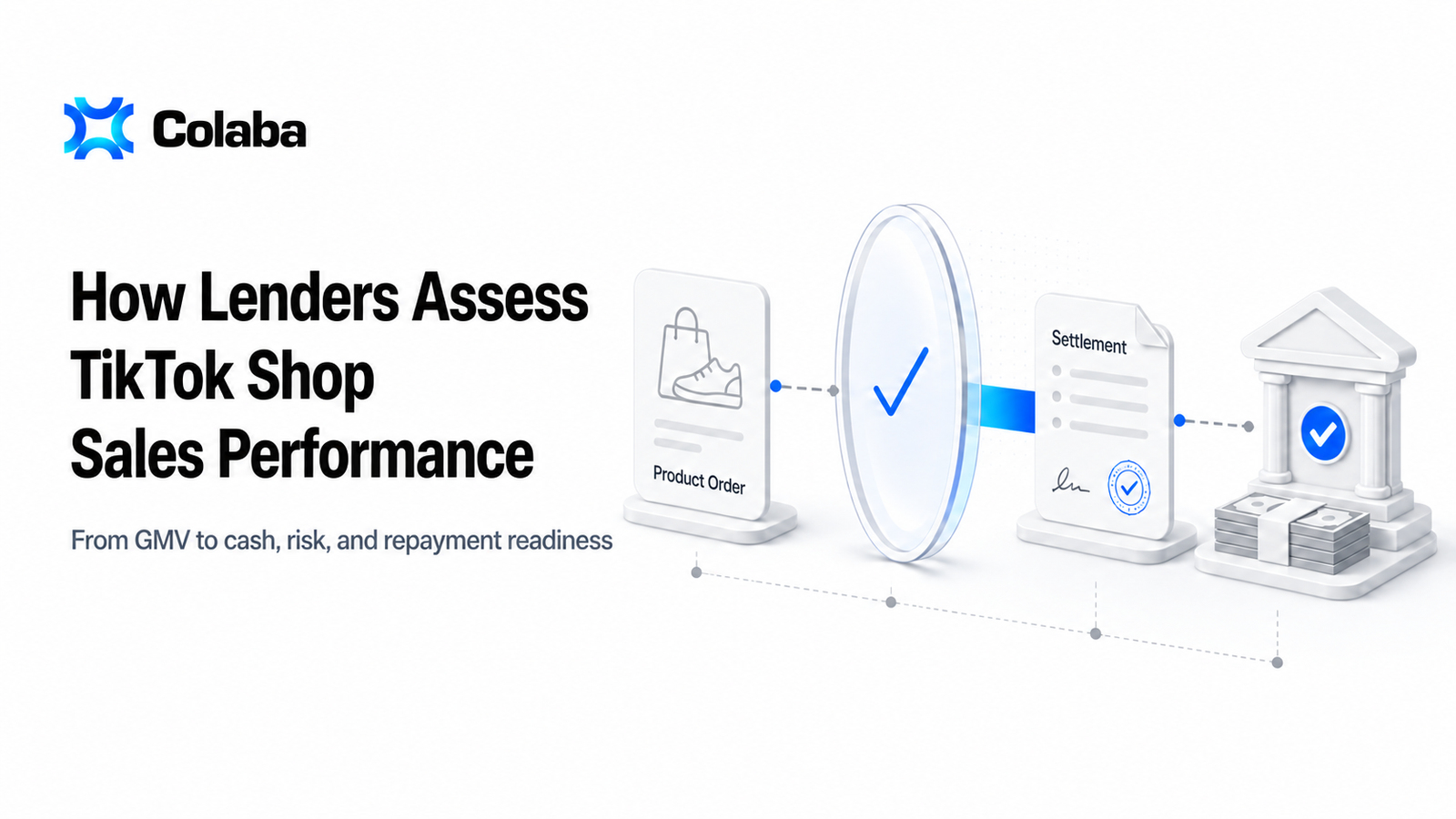
A lender does not assess TikTok Shop sales performance from GMV alone. A credible review connects sales to refunds, fees, margin, settlements, bank deposits, inventory, concentration, and operating controls. The real question is how much dependable cash remains after the costs and risks behind growth.
There is no universal TikTok-specific checklist. Requirements differ by lender, product, borrower, and market. Evidence should show that sales are reconcilable, economics remain positive, results are not dangerously concentrated, and the shop can fulfill orders without creating a refund or working-capital problem.
This guide covers the sales-quality scorecard, GMV-to-cash reconciliation, evidence pack, and stress tests. It is an operating framework—not financial, legal, accounting, or lending advice. Metric labels, attribution, reserves, settlement, and availability vary by market and account; confirm current Seller Center definitions and lender requirements.
Key Takeaways
GMV is a starting point
Reconcile orders to refunds, settlements, bank deposits, and accounting records.
Quality matters more than a spike
Show margin, repeatability, concentration, fulfillment, and customer outcomes.
Use matched definitions
Align time basis, status, attribution window, currency, and refund treatment.
Explain every material gap
A clear exception log is stronger than a dashboard with unexplained differences.
What Lenders Actually Assess
There is no universal minimum GMV or TikTok-specific approval formula. Platform data may support a wider review of repayment capacity, cash flow, obligations, stability, and management quality. Predictable sales with visible margins can be easier to assess than one viral month with high refunds and no bridge to bank cash.
The U.S. Small Business Administration refers to creditworthiness and ability to repay, while an FDIC guide lists financial and cash-flow information among possible lender requests. These are market-specific examples; the broader principle is that shop data supports rather than replaces financial records.
Exports, settlements, deposits, and books should connect.
Refunds, fees, product cost, and acquisition cost must be visible.
Growth needs identifiable drivers, inventory, and a creator pipeline.
Concentration, stockouts, reserves, and seasonality need stress tests.
Every material gap needs evidence, an owner, and an action.
Normalized cash must be tested against proposed payments.
Four evidence layers, not one dashboard
| Evidence layer | What it can show | Typical records | What it cannot prove alone |
|---|---|---|---|
| Commerce | Demand, products, creators, content, refunds | Analytics and order exports | Cash, profit, or accounting revenue |
| Platform finance | Settlements, fees, adjustments, payout status | Statements and payout reports | Receipt in the bank |
| Bank and accounting | Cash, revenue, expenses, liabilities, working capital | Statements, ledger, P&L, balance sheet | Why a creator or product changed |
| Operations | Pipeline, samples, content, follow-up, exceptions | CRM and campaign records | Credit approval |
Sales performance in a credit conversation
Sales performance includes scale, order quality, economics, liquidity, and durability—not only GMV growth.
Read the dimensions together: growth with rising refunds weakens cash conversion; inventory paid before settlement consumes liquidity; one creator can make affiliate GMV fragile.
What a reviewer is likely to challenge
- GMV step-change: Was it a repeatable engine, promotion, platform event, or one viral video?
- GMV-to-bank gap: Is the cause refunds, fees, reserves, processing, adjustments, or cutoff?
- Growth with weak liquidity: How much cash is tied up before settlement?
- Concentration: What happens if the top creator or product disappears?
- Period and adjustments: Are dates aligned and normalizations documented?
Decision rule: Do not send a metric without its definition, source, date basis, status filter, currency, and reconciliation owner. A reviewer should be able to reproduce the number from the underlying export.
Use native data for operational evidence
TikTok’s Sales Analytics guide describes GMV, orders, buyers, refunds, and channel breakdowns. Preserve exports, but do not relabel platform data as audited information. Follow the lender’s required format.
The TikTok Shop Sales Quality Scorecard
The scorecard places demand, order quality, economics, liquidity, concentration, repeatability, fulfillment, and controls side by side. It exposes tradeoffs; it does not predict approval.
| Area | Minimum useful metrics | Evidence | Question answered |
|---|---|---|---|
| Demand | Paid orders, units, GMV, buyers, AOV, growth | Shop Analytics and orders | How large and fast is the sales base? |
| Order quality | Cancellations, refunds, returns, mature-cohort rates | Order and refund exports | How much demand survives? |
| Economics | Net sales, gross margin, contribution, variable cost | Settlement data, costs, P&L | Does growth create value? |
| Liquidity | Settlement lag, on-hold amount, paid amount, deposit match | Payouts and bank statements | When is cash usable? |
| Concentration | Top creator, product, and channel shares | Affiliate and product exports | What dependency can break results? |
| Repeatability | Active, posting, selling, repeat-selling creators | Affiliate Center and CRM | Can the engine continue? |
| Operations | Inventory cover, stockouts, fulfillment, SPS, restrictions | Inventory and account health | Can the shop deliver volume? |
| Controls | Reconciled balance, exceptions, owner, close time | Workbook and sign-off | Can management reproduce the result? |
Demand and order quality
Show values and rates; separate channels only when definitions align. Track count- and value-based refunds using mature cohorts. TikTok’s Shop Analytics documentation shows why status and attribution definitions matter.
Net economics and cash timing
Begin with reconciled net sales and subtract variable costs. Prevent double-counting fees already netted from settlement.
Growth can consume cash when inventory, samples, ads, or fulfillment precede settlement. Compare the cash cycle with supplier terms and obligations.
A result below 100% may reflect cutoff timing, processing, holds, or currency conversion. Age and explain the difference rather than treating it as an automatic failure.
Concentration and repeatability
Calculate GMV and contribution shares for the top creator, top five creators, top product, and top channel.
Show active, posting, selling, and repeat-selling creators. The performance history guide distinguishes spikes from durability. The affiliate operations guide connects discovery through sales; the product-first workflow establishes relevance before outreach.
Inventory, fulfillment, and controls
Track inventory, stockouts, dispatch, cancellations, returns, service, and account issues. TikTok’s Shop Performance Score documentation covers product satisfaction, logistics, and customer service. Use the current account definition.
Connect each metric to cash. A stockout can strand creator momentum; delayed shipping can create refunds; a reserve change can increase working-capital need. Reporting should have named owners, locked definitions, source files, cutoff rules, and an exception log.
Use time windows that reveal both momentum and durability
Orders, refunds, stock, creators, and exceptions.
Settlements, payouts, inventory, and volatility.
Concentration, mature refunds, and cohorts.
Seasonality, margin, and major events.
Label each window. Refunds need cohort maturity; payouts follow settlement; inventory uses supplier horizons; creator operations need weekly indicators. Connect followers, messages, samples, views, and GMV to the next outcome and action.
Reconcile TikTok Shop GMV to Settlement and Cash
GMV is not revenue, profit, settlement, payout, or bank cash. TikTok’s Product Analytics guide covers product-level GMV, orders, and units, while its settlement guide uses settlement timing and includes fees and adjustments. Similar date ranges can therefore produce different totals.
GMV, status, cancellations, and refunds.
Mature cohorts after value reversals.
Revenue, fees, reserves, and adjustments.
On hold, processing, paid, or reversed.
Deposits and accounting entries.
The seven-step reconciliation workflow
| Step | Control | Required output |
|---|---|---|
| 1. Freeze definitions | Record shop, currency, timezone, date field, status, attribution, refund rule, and cutoff | Signed control header |
| 2. Retain exports | Keep raw files unchanged; separate calculations and commentary | Timestamped source archive |
| 3. Create keys | Preserve order, settlement, payout, event, amount, status, and currency IDs | Transaction mapping table |
| 4. Mature orders | Isolate cancellations, refunds, returns, and value reversals by cohort | GMV-to-net-sales bridge |
| 5. Map settlements | Classify revenue, fees, commissions, shipping, incentives, reserves, and adjustments | Net-sales-to-settlement bridge |
| 6. Match payouts | Match paid amounts to deposits; age on-hold, processing, and reversed items | Payout aging and bank match |
| 7. Close to books | Map deposits and balances to ledger accounts under the accounting policy | Finance-approved close bridge |
Order date explains demand; settlement date, platform finance; bank date, liquidity; accounting period, the books. Preserve native GMV and add adjustment columns. TikTok’s Earnings Analytics guide covers revenue and fees, while its finance FAQ covers payout statuses. Reconcile exports, not screenshot totals.
Worked example: the difference between headline GMV and usable cash
The simplified example below shows why a lender may ask for more than the dashboard total. It is illustrative, excludes tax and many possible adjustments, and is not an accounting template.
| Bridge line | Illustrative amount | Interpretation |
|---|---|---|
| Paid-order GMV under the selected report definition | $500,000 | Headline commerce value; not assumed to equal revenue or cash |
| Less cancellations and refunds for the compatible cohort | ($50,000) | Value that did not remain in the mature sales base |
| Mature order value after those reversals | $450,000 | Intermediate operating measure |
| Less platform fees, affiliate commissions, seller shipping, and adjustments | ($90,000) | Illustrative platform-side deductions |
| Settlement amount | $360,000 | Amount represented in the settlement population |
| Less amount still on hold or processing at cutoff | ($20,000) | Timing item carried to the payout aging schedule |
| Paid amount matched to bank deposits | $340,000 | Verified cash received for the reconciled population |
| Less product cost and other variable operating cost outside the platform | ($235,000) | Illustrative COGS and other variable cash costs |
| Illustrative contribution cash proxy | $105,000 | Management measure requiring documented scope and accounting review |
This does not imply a typical or acceptable margin. It shows the sequence from demand through reversals, deductions, cutoff timing, bank receipt, and operating cost.
Common mismatches and how to resolve them
| Observed mismatch | Likely cause | Resolution test | Evidence to retain |
|---|---|---|---|
| GMV exceeds settlement-related revenue | Refunds, status, date, or definition | Rebuild by mature cohort | Orders, refunds, settlements |
| Settlement exceeds deposits | Hold, processing, cutoff, or batching | Age and match later deposits | Payouts and bank |
| Deposit differs from one settlement | Batching, netting, reversal, FX, or fee | Many-to-many mapping | Deposit and payout IDs |
| Affiliate reports differ | Attribution, status, timezone, or scope | Align settings and cohort | Settings and dictionary |
| P&L differs from payout month | Recognition and settlement timing | Bridge the accounting period | Close and ledger |
| Refund rate changes later | Cohort was not mature | Restate at fixed maturity | Cohort snapshots |
Reconciliation standard: Every material difference should be matched, aged, or explained. “The dashboards use different numbers” is an observation, not a resolution.
Treat settlement policy as a working-capital variable
TikTok’s settlement and reserve policy documentation shows that timing can relate to shop performance and other conditions in the covered market. Use current account terms. Model current timing, slower payout, and a temporary reserve or hold, then test whether suppliers, inventory, fulfillment, advertising, and creator commitments can still be funded.
Build a Lender-Ready TikTok Shop Evidence Pack
The pack should be compact enough to review and detailed enough to reproduce—not a folder of screenshots. Follow the lender’s checklist, portal, and file format when supplied.
Pack structure and ownership
| Pack component | Purpose | Minimum control | Owner |
|---|---|---|---|
| Executive summary | Business model, use of funds, drivers, risks | Period, assumptions, comparisons | Management |
| Scorecard | Weekly, monthly, trailing, and downside views | Metric codes and maturity labels | Analytics |
| GMV-to-cash workbook | Orders, refunds, settlements, payouts, bank, books | Raw tabs protected; sign-off recorded | Finance and operations |
| Sales-quality workbook | Creator, product, channel, refund, and contribution cohorts | Stable IDs and aligned attribution | Commerce analytics |
| Financial records | P&L, balance sheet, cash flow, bank, ledger | Periods and entity scope align | Finance |
| Inventory and fulfillment | Stock cover, landed cost, lead time, service quality | Current data and issue actions | Supply chain |
| Creator pipeline | Qualified through repeat-selling stages | Stable IDs and stage definitions | Creator operations |
| Exception log | Issue, amount, cause, evidence, owner, due date | Unresolved total reported | Pack coordinator |
For the sales-quality workbook, TikTok’s Affiliate Center analytics guide describes creator, product, content, traffic, and sales views that may be available. Preserve the range and attribution context. For every metric, record its definition, formula, source, date basis, status population, currency treatment, maturity rule, refresh cadence, owner, and limitation.
Explain use of funds and material variance
Tie the requested amount to inventory, a measured settlement gap, fulfillment capacity, or another documented constraint—not simply “more GMV.” Show amount, timing, assumption, downside case, and repayment source. Explain each material change with the same five fields:
- Observation: period and value.
- Driver: product, creator cohort, campaign, policy, or event.
- Evidence: source export and reconciliation line.
- Implication: margin, cash, concentration, inventory, or service effect.
- Action: owner, due date, and confirmation metric.
Example: “GMV rose after eight creators posted for one product. Top-five concentration increased while mature refunds stayed within the prior range. The team expanded qualified creator outreach and stock-cover monitoring. The downside case removes the top creator and slows settlement.”
If affiliates are material, use stable stages—qualified, contacted, accepted, sampled, delivered, posted, selling, repeat-selling—and measure conversion and elapsed time. The guide to why creator outreach fails helps diagnose pipeline constraints.
Pre-submission tracking checklist
- Confirm period, entity, file, and portal requirements.
- Freeze timezone, currency, date, status, attribution, and maturity rules.
- Retain original order, refund, settlement, payout, product, and affiliate exports.
- Reconcile settlement statuses, deposits, books, and next-period timing items.
- Calculate refunds, contribution, cash conversion, concentration, and inventory cover.
- Label provisional cohorts and document promotions, viral events, stockouts, restrictions, and reserves.
- Run downside cases and obtain operations and finance sign-off.
- Remove unnecessary personal data and use the lender’s secure channel.
Submission principle: Give the lender the requested evidence, not unrestricted access to every operating system. Protect customer, creator, employee, and banking data, and follow the lender’s secure submission process.
Stress-Test the Sales Story Before a Lender Does
A stress test exposes the assumptions behind the forecast, quantifies the cash impact when one fails, and shows management’s response. It does not predict the exact downside.
Run six operating stress tests
| Stress case | Model change | Metrics affected | Management evidence |
|---|---|---|---|
| Top creator stops | Remove that creator’s orders | GMV, margin, concentration | Replacement and repeat-selling depth |
| Product stockout | Delay replenishment | Orders, cash cycle, creator output | Lead time, safety stock, substitutes |
| Refunds rise | Add points to mature refunds | Net sales, settlement, liquidity | Reasons, product fixes, content controls |
| Variable cost rises | Increase commission or ads | Contribution and cash | Segmentation and margin guardrails |
| Settlement slows | Extend payout or add a hold | Working-capital need | Cash buffer, terms, spend controls |
| Viral month is removed | Use a cohort run rate | Growth and forecast | Pipeline and repeat demand |
Use an illustrative coverage view carefully
A management model may compare normalized operating cash flow with planned payments. A lender may define cash flow, add-backs, coverage, and periods differently, so do not present the internal ratio as an approval formula.
Show base, downside, and severe-but-plausible cases, and document every normalization. If coverage collapses when one creator is removed or one payout is delayed, disclose that dependency. Distinguish a temporary operating issue—with cause, owner, action, and due date—from a structural issue such as negative contribution or a cash cycle that cannot support planned growth.
How Colaba supports the operating record
Colaba is not a lender, accounting system, or bank-reconciliation tool. It supports the creator-operations layer: discovery, outreach, campaigns, communications, and performance context. Teams can trace creator qualification, products, samples, posts, repeat sellers, and follow-up gaps behind affiliate results. Native TikTok finance data, bank records, and accounting ownership remain necessary for the financial bridge.
Teams comparing tools can use the affiliate management software guide. Confirmed buyers can review Colaba pricing.
Turn TikTok Shop activity into a defensible operating record
See how Colaba helps teams organize creator, campaign, content, affiliate sales, and workflow evidence for faster performance reviews.
Final review
- Can each headline number be reproduced from a named source?
- Are GMV, net sales, settlement, payout, bank cash, and revenue distinct?
- Are provisional refunds, variable costs, and concentration visible?
- Are current policy and settlement assumptions documented?
- Does every anomaly have evidence, an owner, and a due date?
- Have operations and finance approved their sections?
If the answer to one of these questions is no, repair the evidence before adding more charts. A shorter, reconciled pack with explicit limitations is more useful than a large dashboard collection that cannot be reproduced.
Frequently Asked Questions
Do lenders treat TikTok Shop GMV as revenue?
Not automatically. GMV is a platform commerce metric whose definition may include amounts or statuses that differ from accounting revenue, settlement, profit, and cash. A lender may use it as demand evidence, but the business should reconcile it to refunds, fees, settlements, bank deposits, and financial statements.
How much TikTok Shop sales history should a business prepare?
Prepare the period requested by the lender. A practical internal pack often combines 13 recent weekly periods, a trailing 90-day view, and 12 monthly periods so reviewers can see current momentum, cohort maturity, volatility, and seasonality. Newer shops should provide all available history and label limitations clearly.
How do you reconcile TikTok Shop GMV to bank cash?
Freeze the metric and date definitions, retain raw order and refund exports, bridge the mature order population to settlement lines, classify fees and adjustments, age amounts on hold or processing, match paid payouts to bank deposits, and reconcile the result to the accounting records. Every material difference should be matched, aged, or explained.
What belongs in a lender-ready TikTok Shop evidence pack?
Include an executive summary, controlled scorecard, GMV-to-cash reconciliation, source exports, settlement and payout reports, bank and financial statements, inventory and fulfillment evidence, creator and product concentration analysis, a metric dictionary, stress tests, and an exception log. Follow the lender's own checklist when one is provided.
Does TikTok Shop sales data guarantee financing approval?
No. Platform sales data is only one part of a financing assessment. Approval, pricing, limits, collateral, guarantees, repayment terms, and required documents vary by provider, product, business, and market. Confirm requirements directly with the lender and relevant professional advisers.
Can Colaba provide a loan decision or accounting reconciliation?
No. Colaba is not a lender, bank, or accounting system. It supports creator discovery, outreach, campaign workflows, communications, and performance context. Native TikTok finance reports, bank records, and the company's finance or accounting process remain necessary for settlement, cash, and financial-statement reconciliation.