
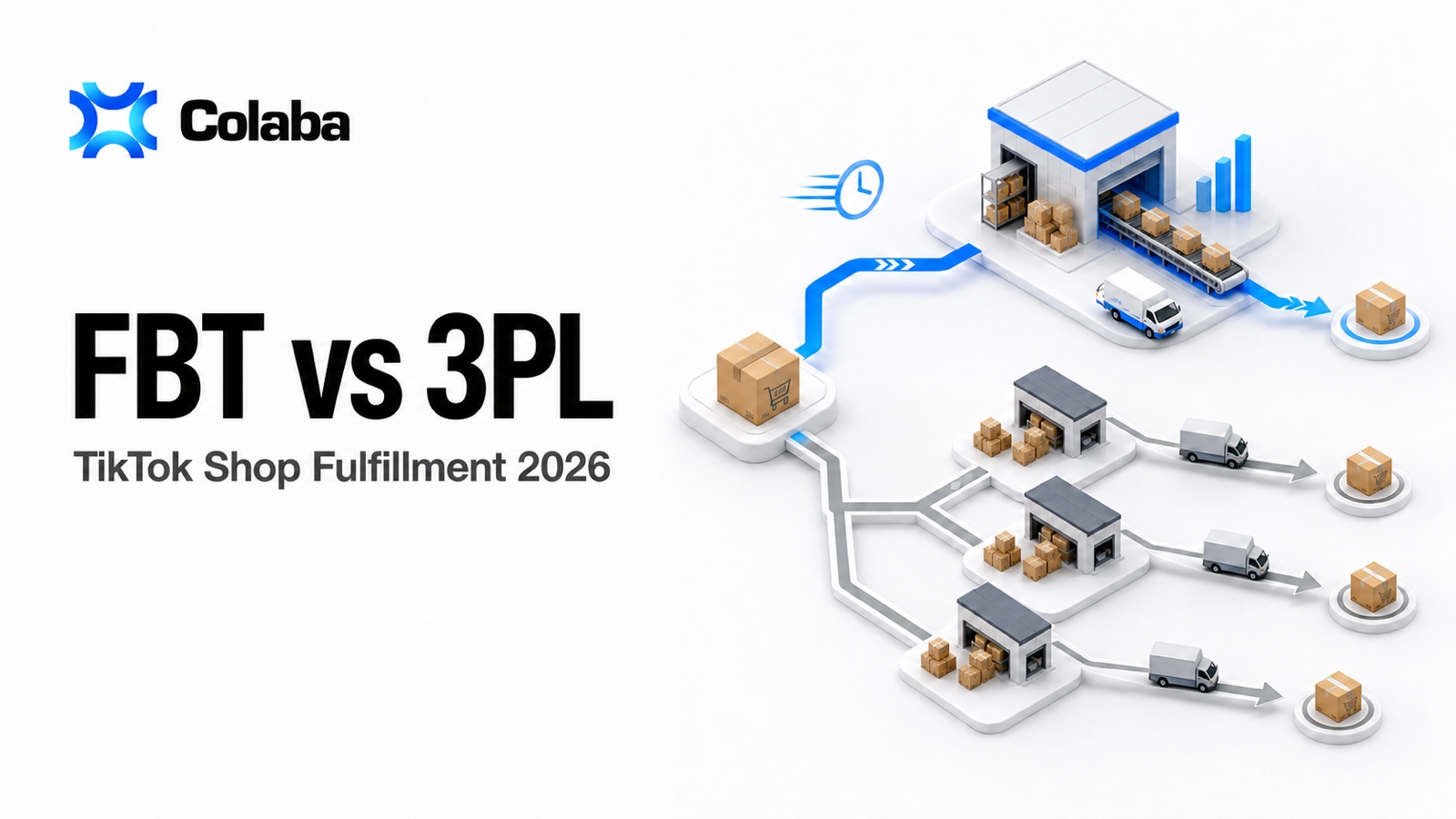
TikTok Shop fulfillment is no longer a back-office decision. As the platform expands, the infrastructure required to convert creator-led demand into reliable delivery becomes a larger part of the growth equation. For wider market context, see the latest TikTok Shop growth statistics for 2026.
Delivery speed affects customer experience, seller performance, campaign readiness, creator activation, and the amount of inventory a brand can safely commit to a viral product. A fulfillment model that works at 20 daily orders can become a bottleneck when a creator video suddenly generates hundreds of orders.
For most U.S. sellers, the practical decision is whether to place inventory with Fulfilled by TikTok (FBT), continue fulfilling through an external warehouse or third-party logistics provider (3PL), or combine both.
The right answer depends on more than the lowest quoted shipping rate. Brands need to evaluate total fulfillment cost, inventory flexibility, channel mix, product characteristics, operational risk, and the speed at which demand changes.
Key Takeaways
FBT Optimizes TikTok Shop Execution
- FBT is TikTok Shop’s in-house warehousing and fulfillment service.
- It is usually strongest for proven TikTok Shop SKUs that need fast delivery and low day-to-day logistics overhead.
A 3PL Optimizes Flexibility
- A 3PL gives the seller more control across packaging, integrations, and sales channels.
- For many scaling brands, a hybrid SKU-level model is stronger than one universal fulfillment choice.
Important terminology: “3PL” is not a separate shipping option inside TikTok Shop. An external fulfillment partner generally operates within an eligible seller-managed shipping workflow.
What Is Fulfilled by TikTok?
Fulfilled by TikTok is TikTok Shop’s in-house fulfillment service. Sellers send inventory to the FBT network, and TikTok manages the downstream fulfillment process.
According to TikTok Shop’s current U.S. documentation, FBT handles:
- Inventory storage
- Order picking and packing
- Last-mile delivery
- Customer returns
- Creator sample orders enrolled in FBT
- Selected logistics issues related to lost or damaged parcels
Eligible products can receive a Free 3-Day Delivery label. TikTok states that its U.S. FBT network uses hubs and fulfillment centers to position products closer to customers.
Sellers can onboard through Seller Center, create goods and inbound orders in the FBT portal, and ship inventory to an assigned location. TikTok also allows sellers to operate FBT inventory and their own warehouse inventory at the same time.
The current requirements, availability, and rate card should always be checked in the official TikTok Shop FBT documentation.
What Does Using a 3PL for TikTok Shop Mean?
A third-party logistics provider is an external company that stores inventory and fulfills orders on behalf of the seller.
This comparison applies to physical products. Virtual goods follow different eligibility and delivery requirements, which are covered in the TikTok Shop digital products guide.
Depending on the provider, a 3PL may handle:
- Receiving and storing inventory
- Picking and packing orders
- Purchasing or processing shipping labels
- Passing tracking information to sales channels
- Returns
- Kitting and bundles
- Custom packaging
- Fulfillment for TikTok Shop, Shopify, Amazon, and other channels
There is an important terminology distinction: TikTok Shop does not list “3PL” as a standalone fulfillment type.
TikTok Shop’s official U.S. logistics options include FBT, TikTok-managed shipping options, and eligible seller-managed shipping. A seller using a 3PL still needs to configure an available TikTok Shop shipping method and ensure that the provider can meet its technical, carrier, tracking, dispatch, and delivery requirements.
Seller-managed shipping may only be available to eligible sellers. Brands should confirm the options shown under Seller Center → Orders → Logistics → Shipping before signing a long-term 3PL agreement.
TikTok outlines the current models in its Logistics and Fulfillment guide.
FBT vs 3PL: Quick Comparison
| Decision factor | FBT | External 3PL |
|---|---|---|
| TikTok Shop integration | Native | Depends on the provider and seller eligibility |
| Delivery experience | Designed around TikTok Shop requirements | Depends on warehouse coverage and carrier setup |
| Operational workload | Lower for FBT orders | More seller and integration oversight |
| Inventory control | More standardized | Usually more flexible |
| Multi-channel fulfillment | Primarily TikTok Shop-focused | Often supports several channels |
| Custom packaging | Limited by FBT requirements | Often available at an additional cost |
| Bundles and kitting | Subject to FBT capabilities and rules | Usually more configurable |
| Returns | Managed within the FBT workflow | Depends on the 3PL contract |
| Logistics metric exposure | TikTok manages most logistics responsibility for FBT orders | Seller remains responsible for provider performance |
| Cost structure | Fulfillment, storage, placement, and related fees | Storage, pick-and-pack, postage, account, integration, and special handling fees |
| Best fit | TikTok-native volume and proven SKUs | Multi-channel or operationally complex brands |
Where FBT Has an Advantage
1. Lower Day-to-Day Fulfillment Complexity
Once inventory is received and available, TikTok handles the operational steps between order creation and delivery.
This reduces the number of systems, carrier relationships, and fulfillment exceptions the seller must manage directly. It can be particularly valuable for small teams whose growth depends on merchandising and creator partnerships rather than logistics expertise.
2. A TikTok-Native Delivery Experience
Eligible FBT products can receive free three-day delivery messaging. Fast, visible delivery promises can reduce friction for customers who discover a product in a video and are considering an immediate purchase.
TikTok also states that FBT orders receive protection from most logistics-related seller-performance enforcement because TikTok controls the fulfillment process. Sellers should review the exact scope of this protection in the current policy rather than treating it as protection from every possible account or customer-service issue.
3. Better Readiness for Creator-Driven Demand
Creator commerce can produce highly uneven demand. A product may have low baseline volume before a successful affiliate video or LIVE session creates a sudden spike. Demand volatility can be especially important in product categories built around demonstrations, reviews, and creator recommendations; our analysis of the best TikTok Shop categories for creator collaborations explains where that dynamic is most visible.
LIVE events can compress even more demand into a short window. Brands using this format should align warehouse capacity and safety stock with their programming plan. See how TikTok Shop LIVE is reshaping U.S. ecommerce.
Placing adequate inventory inside the FBT network can reduce the seller’s direct picking and dispatch workload during these spikes. This does not eliminate inventory planning risk, but it can remove warehouse throughput as an immediate constraint.
4. Simplified Creator Sample Fulfillment
TikTok’s FBT documentation states that creator sample orders can be fulfilled through the same network. This can shorten the operational path between approving a sample and getting the product into a creator’s hands.
However, the standard FBT fulfillment fee still applies to creator sample orders. Faster sample shipping only creates value if the brand is qualifying creators carefully and following up after delivery.
Where FBT Can Become a Constraint
Inventory Must Be Positioned in Advance
FBT cannot fulfill products that have not been received and made available in its network. Sellers therefore need to decide how much inventory to allocate before demand is known.
Sending too little inventory can lead to stockouts during a successful creator campaign. Sending too much can create storage costs, slow-moving inventory, and additional removal or return-to-seller expenses.
The Fee Is More Than a Shipping Rate
FBT costs may include fulfillment, storage, inbound transportation, hub placement, removal, disposal, or other applicable charges.
TikTok publishes weight- and dimension-based rate cards that can change. Sellers should model the actual SKU mix instead of relying on a general claim that FBT is always cheaper.
The current charges are available in TikTok Shop’s FBT Rate Card and FAQ.
Less Control Over the Unboxing Experience
Brands that rely on custom inserts, premium packaging, handwritten materials, complex bundles, or channel-specific unboxing experiences may find a standardized network restrictive.
Before moving a product, confirm that its packaging and preparation requirements fit FBT rules.
TikTok Inventory Can Become a Separate Inventory Pool
A brand selling through TikTok Shop, Shopify, Amazon, wholesale, and retail needs to decide where every unit should sit.
Inventory committed to FBT may not be as flexible as inventory in a warehouse designed to serve the entire channel portfolio. That matters when demand shifts between channels or working capital is limited.
Where a 3PL Has an Advantage
1. Multi-Channel Inventory
A 3PL can often fulfill TikTok Shop, a DTC website, marketplaces, subscriptions, and wholesale orders from one inventory pool.
This reduces fragmented stock and can make demand planning easier. For brands where TikTok Shop is one of several meaningful channels, this flexibility may be more valuable than a platform-native fulfillment badge. The broader strategic roles of each channel are compared in TikTok Shop vs Amazon vs Google Shopping.
2. Greater Operational Control
The right provider may support branded packaging, marketing inserts, subscription preparation, bundling and kitting, lot and expiration-date controls, returns inspection, international shipping, and specialized handling.
The value depends heavily on the provider’s contract and actual warehouse performance. “Flexible” does not automatically mean “reliable.”
3. Easier Portfolio-Wide Cost Management
A multi-channel brand can negotiate logistics based on its total order volume rather than TikTok Shop volume alone.
This may improve warehouse utilization and carrier economics, although account fees, technology fees, minimum monthly charges, and special handling can erase the apparent savings.
4. Less Dependence on One Marketplace
Keeping fulfillment infrastructure outside TikTok Shop gives a seller more control if platform rules, fees, eligibility, or channel priorities change.
This is strategically important for brands building an independent customer base rather than treating TikTok Shop as the entire business.
The Main Risks of Using a 3PL
The seller remains responsible for whether its fulfillment partner performs.
If the 3PL misses dispatch deadlines, uploads invalid tracking, ships the wrong product, or cannot process a viral spike, the customer sees the brand—not the warehouse—as responsible.
TikTok Shop currently applies fulfillment SLAs covering dispatch, delivery, tracking, and automatic cancellation. The exact requirements differ by order and shipping type, so they should be verified in the current Customer Order Shipping Requirements.
A 3PL should not be approved only because it integrates with TikTok Shop. Sellers should ask for evidence of:
- On-time dispatch performance
- Carrier acceptance scan speed
- Tracking synchronization
- Weekend and peak-volume capacity
- Inventory accuracy
- Returns processing time
- Support response times
- Experience with TikTok Shop orders
How to Compare the Real Cost
Comparing FBT’s fulfillment fee with a 3PL’s pick-and-pack fee is misleading. The two numbers may include different services.
Total fulfillment cost per order =
Fulfillment fee + storage + inbound transportation + packaging + last-mile shipping + returns + removal or disposal + integration and account fees + operational labor + cost of errors, cancellations, and stockouts
Run the calculation separately for:
- Single-unit and multi-unit orders
- Lightweight and oversized products
- Fast- and slow-moving SKUs
- Customer orders and creator samples
- Normal weeks and campaign peaks
The cheapest provider under normal volume may become the most expensive during a demand spike or after long-term storage charges begin.
Real SKU Cost Comparison
These modeled totals use comparable assumptions for the same TikTok Shop volume, inbound freight, storage duration, return profile, and packaging needs.
| SKU | Assumptions | FBT total cost per order | 3PL total cost per order | Recommended choice |
|---|---|---|---|---|
| Standard beauty SKU | 150 orders/mo, 8 oz, 9x6x2 in, single unit, low returns | $6.65 | $7.35 | FBT for fastest delivery and lower total cost |
| Small electronics accessory | 90 orders/mo, 14 oz, 10x8x2 in, branded insert, multi-channel demand | $8.40 | $7.90 | 3PL if custom packaging and cross-channel inventory are priorities |
| Seasonal bundle kit | 45 orders/mo, 1.8 lb, 12x10x6 in, bundled packaging, variable demand | $9.20 | $8.85 | Hybrid pilot: FBT for campaign-ready stock, 3PL for overflow and returns |
On this practical example, FBT wins for proven, standard-size TikTok hero products, while a 3PL is stronger for specialized items that need custom packaging or multi-channel inventory. A hybrid allocation is the safest path for seasonal bundles with uncertain demand.
Fulfillment KPIs to Track After the Decision
The fulfillment decision is not complete when inventory moves. The operating model should be reviewed using customer, platform, inventory, financial, and creator-program indicators. Each measure needs one definition, one source, one review cadence, and an owner who can take corrective action.
Averages alone are insufficient. Segment the results by fulfillment method, SKU, warehouse, carrier, order composition, and campaign period. A blended delivery time can hide a weak provider, while a portfolio-level margin can hide a SKU whose storage and return profile makes the fulfillment method uneconomic.
| Metric | What it measures | How to use it | Primary owner |
|---|---|---|---|
| Fulfillment cost per delivered order | All fulfillment-related costs divided by successfully delivered orders. | Compare methods after including storage, inbound, returns, packaging, and operational overhead. | Finance and operations |
| Contribution margin after fulfillment | Order contribution after product, marketplace, promotion, commission, and fulfillment costs. | Determine whether faster delivery creates profitable growth rather than GMV without adequate margin. | Finance and ecommerce |
| Order-to-dispatch time | Elapsed time from a confirmed order to the required dispatch event. | Locate warehouse latency and compare normal days with creator or LIVE demand spikes. | Operations |
| Delivery time | Elapsed time from order or dispatch to confirmed delivery, using one consistent definition. | Evaluate the customer promise by region, carrier, method, and order type. | Operations and CX |
| Cancellation rate related to fulfillment | Orders canceled because stock, dispatch, tracking, or fulfillment execution failed. | Separate logistics failures from customer-led cancellation and product-demand issues. | Operations |
| Inventory accuracy | Alignment between recorded available stock and verified physical inventory. | Identify synchronization problems before they create overselling or unnecessary stockouts. | Inventory planning |
| Stockout rate | Frequency or duration with which a sellable SKU cannot accept expected demand. | Review alongside sell-through and working capital; a low stockout rate is not useful if achieved through excessive inventory. | Inventory planning |
| Storage age | Time units remain in a fulfillment location before sale, removal, or disposal. | Flag slow inventory and adjust replenishment before long-term storage erodes margin. | Inventory planning and finance |
| Return processing time | Time from return receipt to inspection, refund workflow, restock, or final disposition. | Measure how quickly inventory and customer issues reach a usable resolution. | CX and operations |
| Creator sample delivery time | Time from approved sample to confirmed receipt by the creator. | Assess logistics friction inside the creator activation funnel without treating delivery as content completion. | Affiliate operations |
| Sample-to-content activation | Share of delivered samples that progress to the defined content milestone. | Connect fulfillment speed with qualification and follow-up quality; avoid attributing activation to shipping alone. | Affiliate operations |
Review leading indicators weekly during a pilot and business outcomes over a period long enough to capture delivery, returns, and campaign variability. Do not create universal benchmarks without evidence from the brand’s own category, economics, customer geography, and service promise.
When FBT Is the Better Choice
FBT is usually the stronger starting point when:
- TikTok Shop is a primary growth channel
- The brand has a small logistics team
- Products have predictable dimensions and preparation requirements
- Fast delivery is commercially important
- The SKU already has proven TikTok Shop demand
- Creator campaigns can cause rapid order spikes
- The seller wants to reduce exposure to logistics-related performance issues
FBT is less compelling when inventory is highly seasonal, products require specialized handling, or the business needs one highly flexible multi-channel inventory pool.
When a 3PL Is the Better Choice
A 3PL is usually stronger when:
- TikTok Shop is one of several sales channels
- Inventory flexibility is more important than native fulfillment
- The product requires custom packaging, kitting, or inspection
- The seller has strong warehouse integrations and operations expertise
- A proven 3PL already meets TikTok Shop SLAs
- The brand needs more control over returns and the customer experience
- Existing order volume creates meaningful cross-channel shipping leverage
The quality of the provider is the decisive variable. A capable 3PL can be an asset; a weak one can place the seller account and customer experience at risk.
A SKU-Level Scorecard for FBT vs 3PL
Fulfillment should be allocated at SKU level because products create different operational and financial demands. A fast-moving, standard-size hero product should not automatically use the same model as a seasonal bundle, fragile item, slow seller, or product that depends on a branded unboxing experience.
Score each SKU before transferring inventory. The purpose is not to create a mathematically perfect model; it is to make assumptions visible and force the team to compare the same decision factors. Use recent internal data where possible and mark unsupported judgments as hypotheses for the pilot.
| Decision factor | Signal favoring FBT | Signal favoring a 3PL | Evidence to review |
|---|---|---|---|
| TikTok Shop demand | The SKU has repeat, meaningful TikTok Shop volume and is central to creator campaigns. | Demand is early, irregular, or concentrated in other channels. | Orders by channel, sell-through, campaign history, and forecast confidence. |
| Delivery sensitivity | Fast, visible delivery is likely to reduce purchase friction for an impulse-led product. | The customer accepts a specialized or less standardized delivery experience. | Conversion by delivery promise, customer questions, cancellations, and category expectations. |
| Product preparation | The item fits standard preparation, packaging, labeling, and handling requirements. | The item needs custom kitting, inserts, inspection, personalization, or unusual care. | Packaging specification, handling SOP, error history, and provider capability. |
| Inventory flexibility | The brand can dedicate enough units to TikTok Shop without weakening other channels. | The same inventory must remain available across DTC, marketplaces, wholesale, or retail. | Channel forecast, replenishment lead time, safety stock, and working-capital limit. |
| Demand volatility | The brand can pre-position inventory and needs scalable throughput during creator spikes. | Demand is too uncertain to justify a dedicated platform inventory pool. | Creator calendar, LIVE plan, historical peak-to-baseline ratio, and forecast error. |
| Unit economics | FBT’s total modeled cost protects contribution margin for the SKU and order mix. | Negotiated cross-channel economics or specialized handling create a stronger total cost. | Rate cards, dimensions, order composition, storage age, returns, and internal labor. |
| Returns profile | The standardized FBT return workflow fits the category and expected customer behavior. | The brand needs detailed inspection, refurbishment, repackaging, or disposition control. | Return reasons, recovery value, inspection rules, and processing cost. |
| Strategic dependency | TikTok Shop is the SKU’s primary acquisition and transaction channel. | The brand needs operational portability and cannot concentrate fulfillment in one marketplace. | Revenue concentration, acquisition mix, channel strategy, and contingency plan. |
Decision rule: use the scorecard to select the pilot, not to justify a predetermined answer. Re-score the SKU after the test using actual cost, service, inventory, return, and creator-campaign results.
Why a Hybrid Model Often Wins
For a scaling brand, the strongest answer is frequently not “FBT or 3PL.” It is FBT and 3PL with clear SKU allocation rules.
A practical hybrid structure might look like this:
- Use FBT for proven, fast-moving TikTok Shop hero products.
- Keep new, seasonal, slow-moving, or specialized SKUs with the 3PL.
- Retain backup inventory outside FBT.
- Allocate more stock to FBT before a planned creator or LIVE campaign.
- Review sell-through, storage age, stockout frequency, and margin by SKU every week.
TikTok Shop confirms that sellers can use FBT alongside their own warehouse inventory. The platform generally prioritizes available FBT inventory before the seller’s warehouse inventory, so brands should understand the routing behavior before implementing a hybrid model.
A hybrid strategy adds planning complexity, but it also reduces dependence on a single warehouse model and allows the seller to match fulfillment to product economics.
Common FBT and 3PL Migration Mistakes
Most fulfillment failures are not caused by choosing the wrong logo on a comparison slide. They come from moving inventory before the team has validated product data, ownership, routing, replenishment, exceptions, and the timing of creator activity.
| Mistake | Why it happens | Business consequence | Practical correction |
|---|---|---|---|
| Moving the entire catalog at once | The team treats fulfillment as a company-wide vendor decision rather than a SKU-level operating choice. | Slow or unsuitable products create unnecessary storage, preparation, and removal complexity. | Begin with one or two proven SKUs and preserve a reversible path for the rest of the catalog. |
| Using list rates as the business case | Pick-and-pack or fulfillment fees are easier to compare than total cost. | Inbound, storage, returns, packaging, account fees, and internal labor appear only after launch. | Model total cost per delivered order and contribution margin for the actual order mix. |
| Launching creators before inventory is ready | Marketing and fulfillment calendars are planned independently. | Content creates demand while inventory is still inbound, unavailable, or incorrectly configured. | Require inventory receipt and order-flow verification before activating the main creator wave. |
| No backup for the hero SKU | The forecast assumes normal sell-through even though creator demand is volatile. | A successful video or LIVE creates a stockout and shortens the revenue window. | Define safety stock, replenishment trigger, backup inventory, and a decision owner before launch. |
| Incomplete product dimensions or preparation data | Catalog data was created for merchandising, not fulfillment costing and handling. | Fees, labeling, routing, and capacity assumptions may be incorrect. | Audit each pilot SKU’s physical measurements, barcode, packaging, handling, and compliance data. |
| Testing only the happy path | The team verifies that a normal order ships but ignores corrections and returns. | The first cancellation, invalid address, damaged parcel, or tracking error reveals unclear ownership. | Test normal orders and defined exception scenarios before scaling volume. |
| Blending performance across methods | Reporting is organized by total Shop performance instead of fulfillment source and SKU. | The team cannot determine which model caused a cost, service, or inventory change. | Tag the pilot population and compare like-for-like periods, products, regions, and order types. |
| Ignoring creator samples | Sample logistics are treated as a minor affiliate expense rather than an activation stage. | Delivery may improve while qualification and follow-up remain the real bottlenecks. | Track sample approval, delivery, content progression, and next action as separate lifecycle events. |
A migration plan should name the owner for inventory, warehouse setup, Seller Center configuration, creator timing, customer exceptions, financial review, and the final scale-or-stop decision. A provider cannot compensate for missing internal ownership.
Fulfillment and Creator Campaigns Must Be Planned Together
Fulfillment decisions should not sit separately from affiliate strategy.
A creator campaign can fail operationally even when the content performs:
- The brand recruits creators.
- Samples are approved and shipped.
- Content starts generating orders.
- The hero SKU runs out of available inventory.
- Delivery slows or orders are canceled.
- The brand loses sales while creator attention is still peaking.
The opposite failure is also common: a brand sends inventory and samples aggressively before confirming that the product, offer, and creator audience can convert.
The better process connects creator operations with inventory planning:
Creator qualification → Outreach → Sample approval → Sample delivery → Content activation → Demand monitoring → Inventory replenishment
Colaba does not replace FBT or a 3PL. It supports the creator side of this workflow: discovering relevant TikTok Shop creators, evaluating commerce signals, running Invitation, Message, and email outreach, managing sample follow-ups, and monitoring execution across shops.
This helps brands reduce sample waste and coordinate creator activity with the inventory they are prepared to fulfill.
A Practical 30-Day Decision Process
Week 1: Build the Baseline
Calculate the current fulfillment cost, dispatch performance, delivery time, cancellation rate, return cost, and internal labor per order.
Separate the analysis by SKU. Portfolio averages can hide products that are structurally unprofitable to fulfill.
Week 2: Model Both Options
Use the current FBT rate card and a complete 3PL quote.
Include storage duration, inbound shipping, multi-unit orders, packaging, returns, and projected campaign spikes.
Week 3: Run a Controlled Test
Choose one or two proven SKUs rather than moving the entire catalog.
Send limited inventory to FBT while keeping backup units with the existing warehouse. Avoid launching a major creator campaign before the inventory has been received and verified.
Week 4: Compare Business Outcomes
Evaluate:
- Fulfillment cost per delivered order
- On-time dispatch rate
- Delivery time
- Cancellation rate
- Inventory accuracy
- Return handling time
- Stockout rate
- Contribution margin after fulfillment
- Operational hours required
- Creator sample delivery time
- Sample-to-content activation rate
Do not choose a fulfillment model based only on shipping speed or the lowest visible fee. Choose the model that protects contribution margin while supporting reliable growth.
Final Verdict: FBT, 3PL, or Hybrid?
There is no universal winner.
Choose FBT when TikTok Shop is strategically important, the SKU has proven demand, and faster platform-native fulfillment is worth giving up some flexibility.
Choose a 3PL when multi-channel inventory, custom operations, and control matter more than native TikTok Shop fulfillment.
Choose a hybrid model when TikTok Shop is scaling but the business still needs cross-channel flexibility and protection against inventory concentration.
For many established brands, hybrid is the strongest long-term model. FBT becomes the acceleration layer for TikTok Shop’s highest-velocity products, while the 3PL remains the operational backbone for the wider business.
The final decision should be made at the SKU level—not once for the entire company.
Frequently Asked Questions About FBT vs 3PL
Is FBT the same as a 3PL?
FBT performs many functions associated with a 3PL, but it is TikTok Shop’s own fulfillment service. A conventional 3PL is an external provider contracted by the seller.
Can a TikTok Shop seller use both FBT and a 3PL?
Yes. TikTok Shop states that sellers can operate FBT and their own warehouse inventory simultaneously. Sellers should confirm how inventory prioritization and routing apply to their account.
Does FBT fulfill creator samples?
TikTok’s FBT documentation says that creator samples can be processed through FBT. Standard per-unit FBT fulfillment fees apply to Affiliate Program sample orders.
Is FBT always cheaper than a 3PL?
No. The result depends on product dimensions, weight, order composition, storage duration, inbound costs, packaging, returns, and the seller’s negotiated 3PL rates.
Is FBT available to every TikTok Shop seller?
Availability and onboarding conditions can change. Sellers should check the Fulfilled by TikTok section of Seller Center and the latest TikTok Shop documentation.
What should a seller test first?
Start with one or two proven, fast-moving SKUs. Compare total cost, delivery performance, contribution margin, stockout risk, and operational workload before moving more inventory.
Build the Creator Pipeline Behind Your TikTok Shop Growth
Fast fulfillment can protect a successful creator campaign, but it cannot fix weak creator targeting or sample waste.
Colaba helps TikTok Shop sellers, brands, and agencies discover creators, analyze commerce performance, automate multi-channel outreach, manage sample follow-ups, and monitor creator operations from one platform.
Colaba does not replace FBT or a 3PL. It supports the creator-side workflow that determines which samples are worth sending and whether the brand is operationally prepared to turn creator activity into sales.
Connect creator operations with TikTok Shop growth
Centralize creator discovery, outreach, recurring Tasks and sample follow-up.