
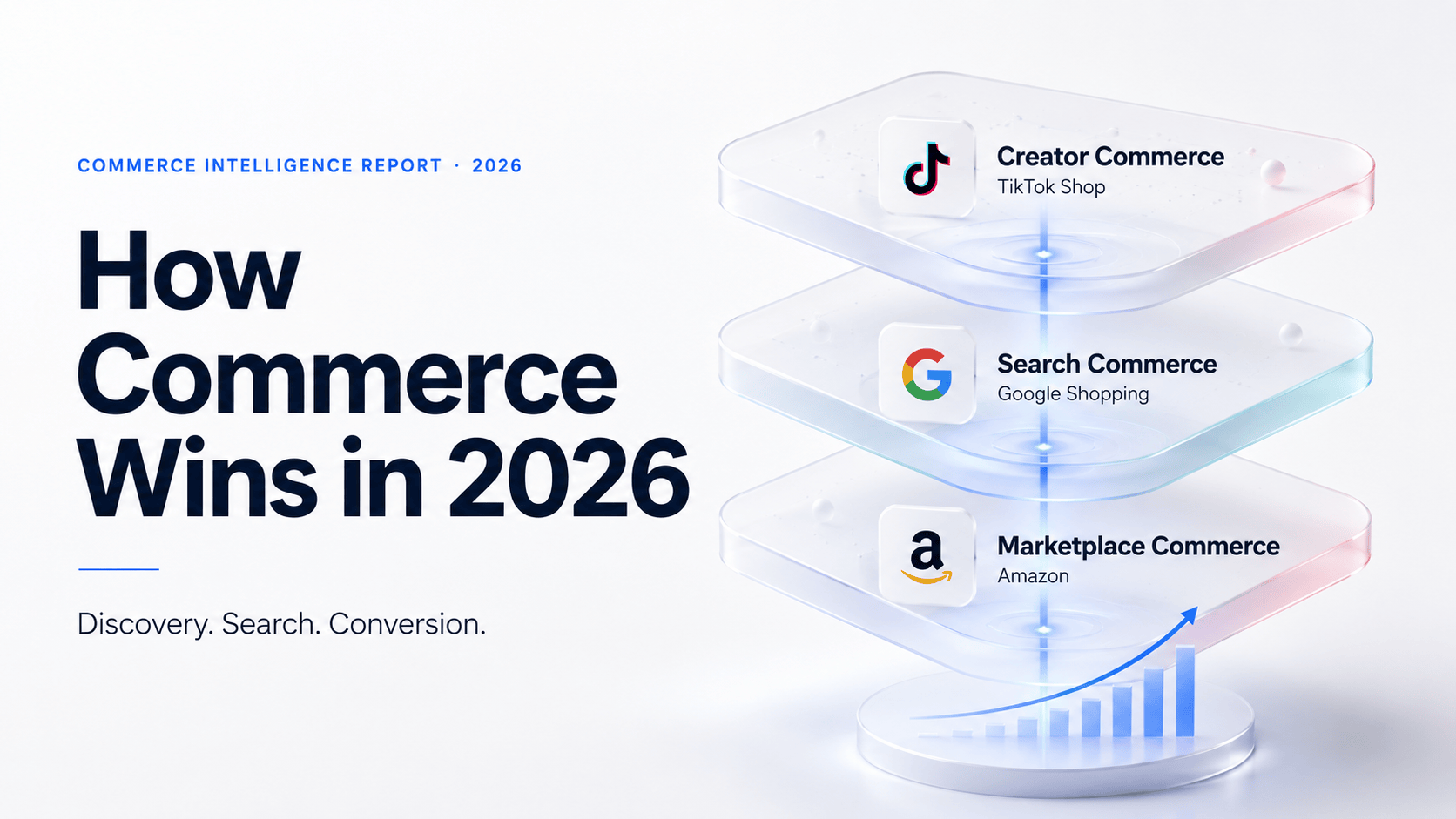
E-commerce is no longer a battle between platforms. It is a battle between demand creation, demand capture, and conversion. TikTok Shop is best for brands that need creator-led discovery, Amazon is best for marketplace buyers and Amazon FBA scale, and Google Shopping is best for capturing shoppers who are already searching.
These platforms can work together. TikTok Shop creates demand through short-form video, creator commerce, affiliate marketing, UGC, and recommendation systems. Google Shopping captures product search intent. Amazon converts high-intent marketplace shoppers through trust, reviews, logistics, and familiar checkout behavior.
This comparison is for TikTok Shop sellers, Amazon FBA operators, DTC brands, agencies, and e-commerce teams deciding where to invest next. The core question is not which platform is universally better, but which channel fits the product, margin structure, content capacity, and customer acquisition model.
The State of E-commerce in 2026
E-commerce growth in 2026 is being shaped by two forces at once: marketplaces that capture existing demand and social commerce platforms that create demand before search begins.
According to EMARKETER’s Worldwide Retail Ecommerce Forecast, global e-commerce sales are expected to exceed $6.8 trillion in 2026, representing more than 21% of total retail sales worldwide. In the United States, long-term forecasts estimate online retail could reach approximately $1.8 trillion by 2030.
E-commerce Growth Over the Last Five Years
| Year | Global E-commerce Sales | Growth | Online Share of Retail | Mobile Commerce Share | Social Commerce Sales | Social Commerce Share |
|---|---|---|---|---|---|---|
| 2021 | $4.9T | +16% | 18.8% | 68% | $492B | 10.0% |
| 2022 | $5.3T | +8% | 19.4% | 70% | $620B | 11.7% |
| 2023 | $5.8T | +9% | 20.1% | 72% | $760B | 13.1% |
| 2024 | $6.3T | +8% | 20.7% | 73% | $920B | 14.6% |
| 2025 | $6.8T | +8% | 21.3% | 74% | $1.1T | 16.2% |
| 2026 | $7.4T | +9% | 21.8% | 75% | $1.3T | 17.6% |
What Sellers Are Discussing in 2026
The main seller concern in 2026 is profitable customer acquisition. Across Amazon FBA, Google Ads, TikTok Shop, and e-commerce communities, brands are trying to reduce CAC without losing growth.
Amazon merchants cite rising PPC costs and margin pressure. Google advertisers report higher acquisition costs and greater dependence on optimization. At the same time, TikTok Shop discussions continue to accelerate as brands explore creator partnerships, affiliate programs, and social commerce.
More competition, higher PPC costs, and margin compression.
Strong intent capture, but less demand creation.
Creators and affiliates create new product demand.
Scalable, performance-based customer acquisition models.
TikTok Shop vs Amazon vs Google Shopping
TikTok Shop vs Amazon vs Google Shopping is not a single-platform decision. Amazon captures marketplace intent, Google Shopping captures search intent, and TikTok Shop creates demand through algorithmic commerce before a search ever happens.
TikTok Shop
Best when brands need to launch products, build awareness, and scale through creators.
- New product launches
- Creator-led sales
- Affiliate programs
- Organic product discovery
Google Shopping
Best when consumers already have search intent and are comparing product options.
- High-intent traffic
- Product comparison
- Search visibility
- Predictable paid scaling
Amazon
Best when brands need to convert shoppers who prefer trusted marketplace buying.
- Marketplace trust
- Ready-to-buy shoppers
- Review-driven conversion
- Large-scale distribution
Is TikTok Shop better than Amazon?
TikTok Shop is better than Amazon for discovery-led products, visual demonstrations, creator commerce, and early demand creation. Amazon is better when shoppers already have purchase intent and value marketplace trust, reviews, fast delivery, and Amazon FBA convenience.
Which platform captures search intent?
Google Shopping captures search intent most directly. When consumers compare products, prices, features, or brands, Google can deliver qualified traffic. Its limitation is that it usually captures demand rather than creating it.
Which platform creates demand?
TikTok Shop creates demand most effectively because products appear inside entertainment feeds, creator recommendations, livestreams, and affiliate content. Recommendation systems can expose products to buyers before they form a search query.
Platform comparison by growth model
| Factor | TikTok Shop | Amazon | Google Shopping |
|---|---|---|---|
| Customer intent | Low-to-mid intent created by content | High marketplace intent | High search and comparison intent |
| Traffic source | Creators, affiliates, For You feed, LIVE | Marketplace search, ads, rankings | Search ads, Shopping listings, product feeds |
| CAC model | Creator commissions, samples, content operations | PPC, promotions, FBA fees, ranking pressure | CPC, feed quality, landing page conversion |
| Content dependency | Very high: UGC and short-form video matter | Medium: listings, images, reviews | Medium: product feed and landing page quality |
| Best use case | Demand creation and creator-led acquisition | Marketplace conversion and operational scale | Demand capture and performance marketing |
Which platform has lower CAC?
TikTok Shop can produce lower CAC when creator content converts organically or affiliates are paid mainly on sales. Amazon and Google Shopping can be more predictable, but CAC often rises as CPCs, competition, and conversion pressure increase.
Can brands use all three platforms?
Yes. A strong omnichannel strategy uses TikTok Shop to create product demand, Google Shopping to capture search demand, and Amazon to convert shoppers who prefer marketplace trust and fast fulfillment.
The Winning Strategy for Sellers in 2026
The Biggest Growth Bottleneck on Each Platform
Each platform can scale, but the bottleneck is different. Amazon is constrained by marketplace competition and ad efficiency, Google Shopping by CPC and conversion rate, and TikTok Shop by creator operations.
| Platform | Primary Growth Driver | Main Advantage | Primary Bottleneck | Typical Scaling Method |
|---|---|---|---|---|
| TikTok Shop | Creator-led demand | Organic discovery & affiliate ecosystem | Managing creator relationships at scale | Creator Discovery → Outreach → Affiliate Activation |
| Amazon | Marketplace demand | High buyer intent & marketplace trust | PPC costs can consume 15–30%+ of revenue in competitive categories | PPC → Reviews → Ranking → Sales Velocity |
| Google Shopping | Search intent | High-converting search traffic | Rising CPCs and conversion rate pressure | Feed → Bids → Clicks → Conversion Rate |
How TikTok Shop Affiliate Marketing Changes the Economics of Growth
One of the biggest drivers behind TikTok Shop's growth is its affiliate ecosystem. Unlike traditional advertising, where brands pay upfront for clicks and impressions, TikTok Shop Affiliates operate on a performance-based model. Creators earn commissions only when they generate sales, reducing acquisition risk for brands.
TikTok Shop affiliate marketing is evolving beyond marketplace sales. Recent U.S. updates allow brands to use creators for TikTok Shop purchases, website traffic, and off-platform conversions. As a result, creators are becoming performance marketing partners rather than simply affiliate publishers.
This expands the businesses that can benefit from creator-led commerce. Smart+ Campaigns, Web-to-App integrations, TikTok Pixel, Events API, and attribution platforms now make creator campaigns relevant for apps, education, gaming, SaaS, lead generation, trials, and subscriptions.
For brands, this changes creator marketing economics. Success depends on repeatable systems for creator discovery, outreach, activation, and performance management. As affiliate programs scale, operational efficiency becomes just as important as advertising efficiency.
What Is TikTok Shop Creator Outreach?
TikTok Shop creator outreach is the process of identifying, contacting, recruiting, and activating creators who can promote products through affiliate partnerships. As affiliate programs grow, brands often move beyond manual recruitment and adopt creator outreach software to manage discovery, communication, follow-ups, and performance tracking at scale.
For many TikTok Shop sellers, creator outreach becomes a core operational function. Successful programs require repeatable creator discovery, affiliate recruitment, relationship management, and performance optimization. For benchmarks, see the Colaba analysis of TikTok Shop creator outreach.
How Colaba Helps Brands Scale TikTok Shop Affiliate Programs
Finding creators is no longer the biggest challenge in TikTok Shop affiliate marketing — scaling creator operations is. As brands grow from a handful of partnerships to hundreds of affiliates, manual workflows become inefficient.
Colaba helps brands identify high-performing TikTok Shop creators using creator analytics and commerce-specific performance signals such as GMV, GMV per video, LIVE performance, audience demographics, revenue trends, engagement quality, and creator activity.
The platform also automates affiliate outreach and creator relationship management, helping teams recruit creators, manage communication, monitor affiliate performance, and optimize programs based on revenue outcomes rather than vanity metrics.
Creator performance infrastructure for TikTok Shop teams
For agencies and multi-store operators, Colaba provides centralized management across multiple TikTok Shop accounts, helping teams scale affiliate programs faster while reducing manual work.
Scale TikTok Shop affiliate outreach with Colaba
Use Colaba to discover high-converting creators, automate outreach, analyze GMV signals, and manage affiliate operations across multiple shops and campaigns.
What the Future of E-commerce Looks Like
The future of e-commerce is omnichannel. TikTok Shop is unlikely to replace Amazon entirely because the two platforms serve different moments in the customer journey, while Google Shopping remains critical for consumers actively searching and comparing products.
The strongest brands will use all three platforms together rather than treating them as competitors.
When to choose each platform
| Business situation | Best platform | Why it works |
|---|---|---|
| New product needs awareness | TikTok Shop | Creators, UGC, and recommendations can create demand quickly. |
| Product has existing search volume | Google Shopping | Search advertising captures shoppers already comparing options. |
| Category has strong marketplace behavior | Amazon | Reviews, Prime behavior, and FBA support conversion. |
| Brand wants durable scale | All three | TikTok creates demand, Google captures search, Amazon converts marketplace buyers. |
Frequently Asked Questions
Is TikTok Shop better than Amazon for new brands?
TikTok Shop often offers faster visibility and lower barriers to entry, while Amazon provides access to a larger marketplace with established buyer trust.
Is Google Shopping still worth investing in?
Yes. Google Shopping remains one of the most effective channels for capturing high-intent search traffic and driving predictable sales.
What is discovery commerce?
Discovery commerce is a shopping model where consumers find products through content, creators, and recommendations rather than actively searching for them.
How does TikTok Shop affiliate marketing work?
TikTok Shop affiliate marketing allows brands to partner with creators who promote products in exchange for commissions on sales. Unlike traditional advertising, brands typically pay for performance rather than exposure. This model helps sellers expand reach through creator content while reducing customer acquisition risk and creating scalable growth opportunities.
Why are brands investing in creators?
Creators build trust with audiences and can drive awareness, engagement, and sales more effectively than many traditional advertising formats.
How can brands scale TikTok Shop affiliate outreach?
Brands can scale TikTok Shop affiliate outreach by building repeatable systems for creator discovery, recruitment, activation, and performance tracking. As affiliate programs grow, manual outreach becomes difficult to manage. Many brands use creator analytics and outreach platforms to identify high-potential creators, automate communication, monitor affiliate performance, and manage creator relationships across multiple campaigns and shops.