
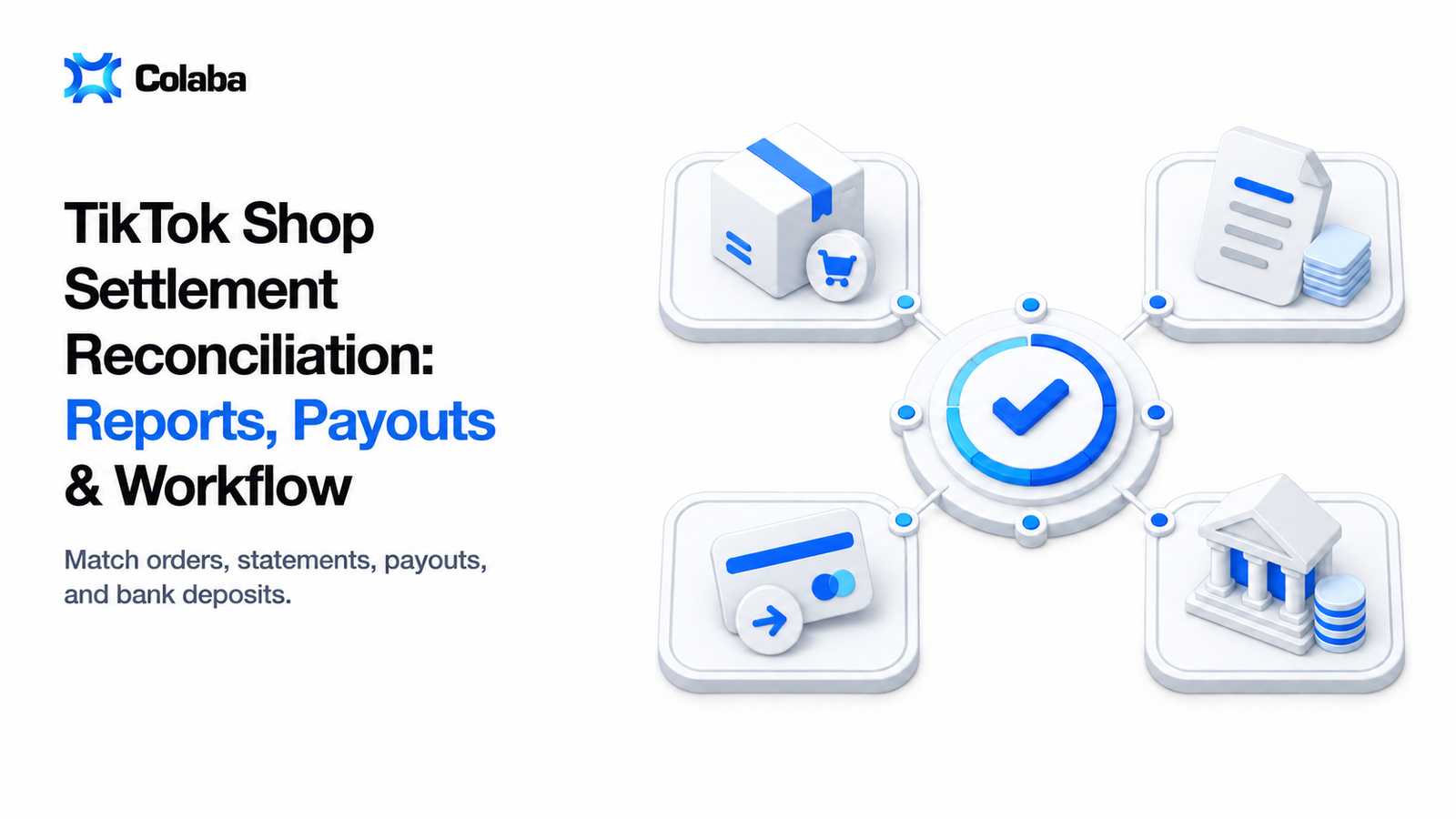
TikTok Shop settlement reconciliation is the process of proving how order and SKU activity became statement value, how statement value became a payout, and how that payout reached the bank.
The central mistake is reconciling order-date sales directly to a bank deposit. TikTok Shop’s settlement report is settlement-based, not order-created-date based. Unsettled orders remain on hold, multiple financial components can appear with positive or negative signs, reserve movement can change the payout, and bank processing can add another time gap.
This guide provides an order-to-bank data model, official field map, formulas, a repeatable close workflow, an exception taxonomy, and controls for refunds, affiliate commissions, shipping, adjustments, reserves, and payout failures. TikTok Shop’s cited finance documentation applies to the United States and was checked on September 6, 2026. Rules, fields, timelines, and availability vary by market and account; use the relevant Seller Center as the current source of truth.
This article addresses finance operations. For marketing attribution and creator KPIs, use the TikTok Shop affiliate tracking guide. For funding-readiness analysis, use How Lenders Assess TikTok Shop Sales Performance.
Key Takeaways
Match in layers
Reconcile order and SKU lines to Statement ID, Statement ID to Payment ID, then payout to the bank.
Respect timing
Order creation, delivery, settlement, reserve release, payout initiation, and bank receipt are different events.
Preserve signs
Calculate from exported signed fields; do not convert every fee, refund, reserve, or adjustment to a positive number.
Separate systems
Seller Center and accounting own financial truth; Colaba can add affiliate-operation context around variances.
What TikTok Shop Settlement Reconciliation Means
TikTok Shop settlement reconciliation is a controlled comparison of platform financial records with operational order records and cash received. It explains every material difference between what was sold, what became eligible for settlement, what TikTok included in a statement, what TikTok initiated as a payout, and what the bank received.
A complete reconciliation has three outputs. First, a matched population showing that records connect through stable identifiers. Second, a variance bridge showing net sales, shipping, fees, adjustments, reserves, and timing. Third, an exception register with an owner, evidence, expected resolution date, and status.
Settlement is not the same as sales
Sales reporting usually starts with an order-created date, product, quantity, gross merchandise value, discount, and later refund status. The official U.S. TikTok Shop settlement guide says its report uses a settlement-based perspective. Only orders that meet settlement rules appear; unsettled orders are shown in Finance > On hold.
That distinction creates expected timing differences. An order can exist in sales analytics but not yet exist in the settlement export. A delivered order can be subject to a settlement tier or reserve. A statement can be generated without a same-day bank receipt. A payout can be delayed by the chosen schedule or bank processing.
Scope boundary: the settlement file explains platform activity and cash movement, not complete profit. Reconcile it first, then apply product cost, overhead, tax, financing, and other expenses under the approved accounting policy.
Why the control matters as TikTok Shop scales
More commerce activity creates more lines, timing states, refunds, commissions, shipping combinations, adjustments, and exceptions. Official TikTok market releases illustrate the pace without proving a universal growth rate. In Brazil, TikTok reported that average daily GMV measured by month grew 102 times between May 2025 and May 2026, while active affiliate creators making at least one daily sale grew 46 times. In Germany, TikTok reported more than 25,000 sellers by March 2026 and said average daily seller sales had nearly doubled over the preceding six months.
Sources and limitations: official TikTok Brazil release, June 4, 2026, and TikTok Germany release, March 24, 2026. These are separate market snapshots with different methods and windows. They are not global forecasts. The inference is operational: rapidly growing transaction and affiliate volume increases the need for repeatable finance controls.
A period is reconciled only when signed components reproduce statement value, statements connect to payouts, reserve explains the bridge, cash matches the bank within the timing window, and remaining variances have an owner and evidence. “The dashboard looks close” is not a control.
The Order-to-Bank Reconciliation Data Model
Keep four layers separate. Orders can contain several SKUs, lines can settle at different times, many lines can enter one statement, statements can feed a payment, and reserve can change payout.
Order ID, SKU ID, quantity, created date, delivered date, discounts, refund state, creator context.
Statement date, Statement ID, line type, signed net sales, shipping, fees, and adjustments.
Payment ID, payout status, statement amount, reserve movement, initiation date, expected cash.
Deposit date, amount, currency, descriptor, bank reference, and accounting posting.
Use identifiers as bridges
Preserve order or adjustment ID and SKU ID at the commercial line, Statement ID at the settlement group, Payment ID at payout initiation, and bank reference at receipt. Store IDs as text, track blanks and duplicates, and never substitute name, rounded amount, or date when a stable identifier exists.
Use dates according to the question
Order creation records demand; delivery can start settlement, commission, or reserve timing; Statement Date records settlement in UTC; payout initiation creates the transfer; bank date records cash. Label each view by date basis, preserve raw UTC, and calculate local reporting dates separately. Sales and settlement can differ while both remain correct.
Build three bridges, not one giant join
Order-to-statement proves SKU economics; statement-to-payout proves transfer composition and reserve; payout-to-bank proves cash. Keep matched, timing, amount variance, missing source, duplicate, failed, and under-review statuses separately so a bank delay does not reopen already-proven statement work.
How to Read the TikTok Shop Settlement Report
TikTok’s official U.S. guide says a settlement report is generated daily based on the settlement period and downloads as an Excel workbook with five spreadsheets. The guide identifies the Order details worksheet as the SKU-level breakdown of settlement information, including fees. Because report formats can change, keep the original workbook, record the export date, and validate headers before loading an automation.
The official download path is Seller Center > Finances > Statements or Payouts > Export. Select the date range, then obtain the file from Export History. The exact interface can vary, so the operational requirement is to document the path and evidence used for each market and account.
Source: TikTok Shop, How to Access Your Settlement Report, U.S. article dated September 11, 2025 and checked September 6, 2026. The report is settlement-based and its structure or fields can change.
The four-part settlement formula
The current U.S. field guide defines Total settlement amount as Net sales plus Shipping plus Fees plus Adjustment amount. In the export, refunds and many charges can already carry negative signs. Reconciliation should therefore sum the signed fields exactly as exported before applying accounting presentation.
The same guide defines Net sales as Gross sales plus Gross sales refund plus Seller discount plus Seller discount refund. That syntax depends on sign conventions: gross sales refund is displayed as a negative value, while the seller discount refund is described as positive. Inspect the actual export and never subtract a field solely because its label contains “fee,” “refund,” or “discount.”
| Amount group | Examples in official documentation | Primary reconciliation check |
|---|---|---|
| Net Sales | Gross sales, gross sales refund, seller discount, seller discount refund. | Reproduce line arithmetic and compare order, refund, and discount status. |
| Shipping | TikTok shipping, customer-paid shipping, refunds, incentives, return shipping, FBT fulfillment, offsets. | Separate customer cash, seller charges, platform incentives, refunds, and fulfillment mode. |
| Fees | Referral fee, refund administration fee, affiliate commission, affiliate partner commission, affiliate shop ads commission. | Check basis, rate, applicable program, refund timing, and sign. |
| Adjustments | Logistics, reimbursements, deductions, policy, promotion, chargeback, ads balance, FBT warehouse, and other items. | Require reason, related order where present, evidence, owner, and close status. |
Affiliate commission fields
The official U.S. report guide states the affiliate commission formula as product price excluding tax minus seller discount, multiplied by the affiliate commission rate. It provides parallel formulas for affiliate partner commission and affiliate shop ads commission. Recalculate a sample at line level using the recorded rate and source values.
Do not assume the commission event and seller settlement always share the same date. The same official guide says that, for orders created after April 15, 2025 UTC, creator commission is typically paid on the fifteenth day after delivery and only after the seller’s order settles; a longer seller settlement period can delay it. Refund timing affects whether commission is returned to the seller, and the official article says commission is non-refundable when the refund starts after the creator has been paid.
Shipping and adjustments
Shipping can include customer payments and refunds, TikTok charges, incentives, return costs, FBT fees, offsets, and services; fulfillment mode changes expected fields. Adjustments can include logistics, sample shipping, reimbursements, policy, fee, promotion, chargeback, ads-balance, and warehouse items. Map funding source and sign, retain related Order ID where present, and trend reason, age, product, Shop, and owner. See FBT vs 3PL for TikTok Shop for the fulfillment context.
Payout amount and reserve movement
TikTok’s U.S. report guide explains the common difference with a direct equation: payout amount equals statement amount plus reserve amount. A positive reserve amount represents release; a negative reserve amount represents funds withheld. The reserve record guide says TikTok calculates and holds a percentage of settlement for a rolling period and later makes unused funds eligible for disbursement when release conditions are met.
Under the U.S. Dynamic Settlement and Reserve Policy dated June 30, 2026, monthly performance reviews determine settlement tier and reserve level, while unused reserves are generally held for 30 days from delivery before release. TikTok says account status or security checks can change the terms. Treat this as a market-specific, changeable rule—not a global constant.
A Repeatable TikTok Shop Reconciliation Workflow
Use the same sequence every close, with named owners, frozen sources, approval thresholds, and carry-forward rules. The aim is zero unexplained material differences.
Shop, market, currency, date basis, timezone, materiality, and close cutoff.
Order, statement, payout, reserve, and bank evidence for the required windows.
Store unchanged files with export timestamp, source path, account, and checksum if used.
Headers, IDs, dates, currency, types, signed numbers, and duplicate keys.
Order/SKU to Statement ID, then Statement ID to Payment ID.
Net sales, shipping, fees, adjustments, statement totals, and reserves.
Payment ID or payout amount to bank deposit within the timing window.
Timing, refund, fee, reserve, adjustment, failure, data, or true variance.
Attach evidence, assign owner, set due date, and document action.
Approve matched totals, open exceptions, carry-forward, and accounting entry.
1–3. Freeze, export, and normalize
Write the Shop, market, entity, currency, date basis, order lookback, payout window, bank account, timezone, materiality, and close cutoff. Use a wider order lookback because older orders can settle, refund, release reserve, or receive adjustments now.
Archive the raw settlement workbook, order export, payout and reserve evidence, and bank activity before editing. Name files by source, Shop, market, range, and export timestamp; record row and header checks. In a separate working layer, keep IDs as text, signed amounts unchanged, raw UTC timestamps intact, and blank distinct from zero.
4. Reconcile order and SKU lines to statements
Start with what settled. Join order or adjustment ID and SKU ID to operational data, then classify unmatched lines as adjustments, older orders, changed identifiers, missing exports, or data issues. Sum signed Net Sales, Shipping, Fees, and Adjustments by Statement ID and preserve the reported, calculated, and variance values.
5. Bridge statements to payouts and reserves
Group statements by Payment ID and status. A blank Payment ID can precede initiation; a failed payout is a separate exception. Add signed reserve movement and recalculate expected payout. Track holds and releases separately.
Maintain opening reserve, holds, releases, other changes, and closing reserve. Positive movement increases payout through release; negative movement reduces it through a hold.
6. Match payout to bank
Match Payment ID or bank reference first; otherwise use amount, currency, initiation date, expected window, and descriptor. TikTok’s U.S. guide says selected sellers may choose daily, business-day, weekly, or monthly schedules and that bank processing typically takes one to three business days. Confirm current account availability before calling in-window cash missing.
Official reference: Scheduling your payouts, TikTok Shop U.S., dated August 20, 2025. The published availability note and processing estimate may change.
7. Classify, resolve, and carry forward exceptions
Give each exception one class, owner, evidence, age, financial effect, next action, due date, and status. Carry open timing items forward and verify the later settlement, release, retry, or cash event.
| Exception class | Typical cause | Evidence | Close rule |
|---|---|---|---|
| Timing | Order not yet eligible, payout processing, reserve hold, late bank posting. | Created, delivered, statement, payout, reserve, and bank dates. | Subsequent event occurs inside policy window and is cross-referenced. |
| Refund or commission | Refund status, commission payment date, non-refundable paid commission. | Order, delivery, refund, commission, statement line, applicable rule. | Amount and treatment agree with the market rule and export. |
| Shipping or fulfillment | Mode, measured weight, return fee, incentive, FBT fee, clawback. | Shipment, weight, fulfillment mode, rate, incentive, order link. | Expected field and amount are supported or escalated. |
| Adjustment | Logistics, policy, promotion, fee correction, chargeback, reimbursement. | Reason, related order, platform notice, support case. | Evidence and accounting mapping approved. |
| Payout failure | Negative balance, threshold, restriction, bank details, processor failure. | Status, Net earnings, account notice, bank setup, retry date. | Retry paid or alternative resolution documented. |
| Data quality | Missing ID, duplicate, changed header, malformed number, truncated date. | Raw file, manifest, transformation log, affected row sample. | Loader or mapping corrected and population rerun. |
| True variance | No supported timing, rule, data, or mapping explanation remains. | Complete bridge and review record. | Corrected, recovered, written off, or formally escalated. |
8. Sign off with a reconciliation control sheet
Show sources, period, currency, counts, reported and calculated totals, reserve bridge, expected and received payouts, open aging, material unresolved value, preparer, reviewer, and status. Link evidence so readers can distinguish final, timing, and actionable amounts.
Controls for Refunds, Reserves, Payouts, and Affiliate Context
Use control totals, status transitions, aging, reason trends, and evidence sampling. TikTok Shop and the bank establish finance and cash; accounting records approved treatment; an affiliate platform can explain creator context.
Refund and affiliate commission control
Under the cited U.S. guide, commission timing can differ from seller settlement and refund treatment depends on whether the creator was paid. Test delivery, settlement tier, creator payment, refund date, rate, and statement line. Check the current rule again for every market.
- Recalculate the line-level commission basis and rate.
- Compare delivery, seller settlement, creator payment, and refund dates.
- Separate affiliate, partner, and shop ads commission and flag late refunds.
Reserve roll-forward control
Reserve is a timing and risk layer, not an unexplained fee. Archive opening balance, holds, releases, and closing balance from the Finance views. The U.S. policy describes five settlement tiers, three reserve levels, monthly review, and a general 30-day hold from delivery; store the applicable policy date because terms can change.
Official references: How to View Your Reserve Record and Dynamic Settlement and Reserve Policy. Both are U.S.-specific; the policy was updated June 30, 2026.
Payout failure control
The U.S. payout FAQ lists negative balance, Net earnings below $1, account restrictions, and invalid bank details as common blockers, with automatic retry after an invalid-account issue is resolved. Use live account evidence and link the retry.
- Payment status is not failed, restricted, or pending beyond the agreed window.
- Net earnings, negative balance, bank details, and schedule are reviewed.
- Retry and subsequent cash match are linked to the original exception.
Adjustment and root-cause trend control
Trend adjustments by reason, product, fulfillment mode, Shop, owner, age, value, and count. Investigate new reasons, repeated corrections, aged items, missing related orders, and changes after promotions or logistics updates.
Connect operational remedies to the relevant source. Shipping and warehouse issues belong in fulfillment operations. Fee or policy questions belong in Seller Center evidence and support. Creator commission or sample-related questions may require campaign and creator context. For a broader lifecycle map, see the TikTok Shop Affiliate Operations guide.
Recommended reconciliation cadence
Review payout failures, negative balances, large adjustments, and source-format changes daily. Recompute statements, bridge reserves, match cash, and age exceptions weekly. Complete accounting close and adjustment trends monthly. Review access, automation, retention, tolerances, taxonomy, and sampling quarterly.
Where Colaba fits—and where it does not
Colaba can add Shop, creator, product, audience, outreach task, collaboration, message, sample, status, note, owner, and performance context around an exception. It is not an accounting ledger, settlement engine, payout processor, reserve calculator, or bank reconciliation system. TikTok Shop, bank, and accounting records remain authoritative; reference their evidence without creating a second version of settled revenue.
Final close checklist
- Raw exports and bank evidence are immutable and discoverable.
- All four amount groups reproduce the reported settlement total.
- Statements map to Payment IDs or a documented pre-payout status.
- Reserve movement explains settlement-to-payout differences.
- Payouts match cash or remain open within the approved timing window.
- Refund and affiliate commission timing use the applicable market rule.
- Adjustments and open items have evidence, owners, aging, and status.
- Approved accounting mapping and reviewer sign-off are retained.
Connect Affiliate Operations to the Exception Review
Use Colaba to keep creator discovery, outreach, communication, tasks, statuses, and multi-Shop context organized around the affiliate program. When finance identifies a creator- or campaign-related variance, the operator can review the relevant relationship and activity record while finance preserves TikTok Shop and bank evidence as the monetary source of truth.
This division of responsibility prevents two common failures: finance trying to reconstruct creator activity from settlement labels alone, and growth teams treating estimated or campaign-level GMV as settled cash. A shared identifier or controlled reference between the exception register and the Colaba record can speed investigation without collapsing the systems.
Add creator context to finance exceptions
See how Colaba can connect affiliate outreach, creator, product, sample, and performance context to the operating review around TikTok Shop finance data.
Frequently Asked Questions
How do you reconcile TikTok Shop settlement reports?
Freeze the Shop, market, currency, dates, timezone, and tolerance; archive raw order, statement, payout, reserve, and bank files; normalize IDs and signed amounts; match order and SKU lines to Statement ID; recalculate settlement components; bridge Statement ID to Payment ID; add reserve movement; match payout to bank; classify exceptions; and retain preparer and reviewer sign-off.
Why does TikTok Shop sales value not match the settlement report?
Sales views can use order-created dates, while the settlement report includes only activity that meets settlement rules. Delivery, refunds, discounts, shipping, fees, adjustments, settlement tier, and timing can move value between periods. Unsettled orders can remain in Finance > On hold.
Why does a TikTok Shop payout not match the statement amount?
TikTok Shop's U.S. documentation states that payout amount equals statement amount plus reserve amount. Positive reserve movement represents a release and negative movement represents a hold. Payout schedule, negative balance, account restrictions, bank details, or processing timing can also affect when cash arrives.
What fields connect a TikTok Shop order to a payout?
Preserve order or adjustment ID and SKU ID for the commercial line, Statement ID for the settlement group, and Payment ID for payout initiation. Use a bank reference when available for cash matching. Store IDs as text and do not substitute product name, creator handle, rounded amount, or date when a stable identifier exists.
What is included in TikTok Shop total settlement amount?
The current TikTok Shop U.S. field guide defines total settlement amount as Net sales plus Shipping plus Fees plus Adjustment amount. The exported values can already contain positive and negative signs, so reconciliation should sum the signed fields before changing the accounting presentation.
How should affiliate commissions be checked in the settlement report?
Recalculate a line sample using product price excluding tax minus seller discount, multiplied by the recorded affiliate commission rate. Then compare delivery, seller settlement, creator payment, and refund dates because commission and seller settlement timing can differ. Use the current rules for the relevant market.
How often should TikTok Shop settlements be reconciled?
Review payout failures and major exceptions daily, reconcile statement totals, reserve movement, cash, and aging weekly, complete formal accounting close monthly, and review access, automation, retention, tolerances, and exception taxonomy quarterly. High-volume or high-risk Shops may need a tighter cadence.
Can Colaba reconcile TikTok Shop payouts to the bank?
Colaba is not presented as an accounting ledger, settlement engine, payout processor, or bank reconciliation system. TikTok Shop finance records, bank activity, and the accounting system remain authoritative. Colaba can provide creator, product, outreach, task, sample, status, note, owner, and performance context around affiliate-related exceptions.